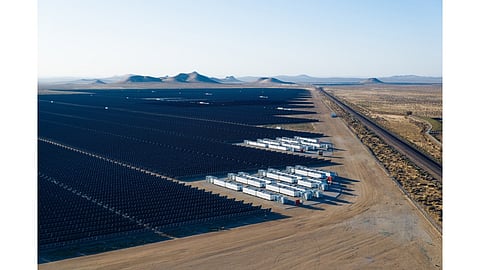


A new IEA PVPS report found that real-world performance of batteries often differs from rated values because of system design, operating conditions and software
It identifies six operational performance indicators to help operators monitor battery health, detect faults, and improve maintenance planning
IEA PVPS says it plans to continue developing harmonized methods and case studies on PV+BESS performance and reliability through 2029
The International Energy Agency Photovoltaic Power Systems Programme (IEA PVPS) Task 13 has published a new report examining the performance and reliability of battery energy storage systems (BESS) integrated with solar PV plants during field operations.
The aim of the report is to review current technologies, define suitable metrics, and highlight research gaps via selected case studies, explains IEA PVPS.
The report comes as the deployment of PV systems paired with battery storage continues to grow across residential, commercial, and utility-scale applications, beyond their widespread use in electric vehicles (EVs) and consumer electronics. In 2025, the world added 104 GW/257 GWh of new BESS capacity, bringing the cumulative total to 267 GW/610 GWh.
According to the report, there is currently limited data on how batteries perform and degrade under real operating conditions in a solar-plus-storage system. It argues that their performance does not depend solely on battery technology but on a number of factors.
Lithium-ion batteries, particularly lithium iron phosphate (LFP) technology, currently dominate the PV storage market due to their combination of cost and performance, the report notes. Now, there is also increasing investment in sodium-ion batteries, among other options available in the market (see CATL Debuts Commercial Sodium-Ion Energy Storage).
However, battery chemistry is only one factor affecting overall system reliability, points out IEA PVPS, with application type and environmental conditions also playing significant roles.
Among other factors that contribute to this are system design, inverter performance, control strategies, operating conditions, temperature, and software. Put together, these can affect efficiency, degradation, and long-term operation of such systems.
“PV + BESS performance in the field is driven by far more than battery chemistry alone,” said Ulrike Jahn, Manager of IEA PVPS Task 13. “This report shows that system topology, inverter behaviour, control logic, operating profile, temperature and firmware all materially shape efficiency, degradation, end-of-life estimation and dispatch reliability.”
The report shares the experiences and learnings from three case studies covering backup power, self-consumption, and grid service applications to prove the above.
One such case study is the Florida SunSmart Schools in the US, where more than 114 solar-plus-storage systems were installed at emergency shelter schools to provide backup power during grid outages. The batteries are designed to undergo approximately 3,000 to 4,000 charge-discharge cycles, and they operate mainly during outages, which helps extend battery life.
The Swedish residential solar-plus-storage system RISE Research Villa promotes self-consumption and self-sufficiency. While the battery system contributes strongly to both of these purposes, available data from the system show that its benefits depend on battery size, operating strategy, and seasonal solar generation. For instance, BESS plays a neutral-to-negative role in winter because there is limited surplus PV power.
Another case study covered in the IEA PVPS report relates to an operational virtual power plant (VPP) managing around 250 MW of battery storage across about 15,000 residential, commercial, and utility-scale systems in Sweden and other Nordic countries.
It shows that reliable grid-supporting battery operation depends not only on battery hardware but also on software, accurate monitoring, thermal management, aging data, and adaptation to evolving electricity market conditions.
With these learnings, analysts recommend monitoring six core performance indicators (PIs) to assess battery state of health and operational reliability. They list these as energy storage capacity, power capacity and tolerance, standby losses, round-trip efficiency, response time, and internal resistance.
“To support their determination, dedicated test duty cycles can be executed while the BESS is at rest from normal operation. Such test cycles can be programmed into the EMS and are generally viewed to enable more accurate determination of PIs than methods based solely on data from normal operation,” suggest the writers.
It says these indicators can help operators detect faults early, optimize charging and discharging strategies, and plan maintenance more effectively.
As the global deployment of PV+BESS systems expands, IEA PVPS says wider access to high-quality operational data and validated battery aging models will be essential to improve system design, predict long-term performance, and support their cost-effective operation.
It plans to continue research on PV and battery storage performance and reliability during the 2026-2029 period.
The complete report titled Assessing the Reliability of Battery Systems in Solar Power Plants in Operation 2026 is available for free download on the IEA PVPS website.
