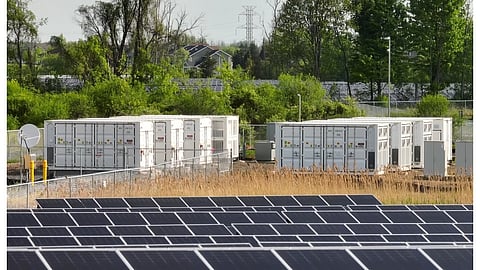


India’s CEA has proposed that new ground-mounted solar and onshore wind projects add co-located storage from July 2027
The proposed rules also introduce grid-forming requirements for renewable energy plants and BESS
Industry voices highlight that the move could reshape project design and procurement practices
India’s Central Electricity Authority (CEA) has proposed making co-located energy storage mandatory for new ground-mounted solar and onshore wind projects commissioned after July 1, 2027.
The proposal is part of draft amendments to the technical standards for construction of electric plants and lines. The CEA proposes that solar and wind energy projects be equipped with an energy storage system (ESS) with a minimum 2-hour storage duration and power capacity equivalent to at least 10% of the plant’s installed capacity.
For instance, a 100 MW solar or wind project would require at least 10 MW of co-located storage capable of discharging for two hours, equivalent to 20 MWh.
The proposed requirement would become more stringent for projects commissioned after July 1, 2029, and up to June 30, 2031. Such projects would continue to require storage equivalent to at least 10% of installed capacity, but the minimum storage duration would increase to four hours.
If implemented, the proposal could create more predictable demand for BESS and related equipment across the supply chain. Moreover, the shift to a 4-hour minimum duration from July 2029 could drive demand for longer-duration storage. This would enable renewable generation to shift to evening hours and lower pressure on the grid.
In the notice, the CEA has also proposed new grid-forming requirements for renewable energy plants commissioned on or after July 1, 2027. At least 15% of inverters and all BESS power conversion systems (PCS) would need grid-forming capability.
The proposal comes as India adds increasing volumes of variable solar and wind generation to the grid. The CEA highlights that by storing excess power generated during periods of low renewable energy generation, ESS would support grid stability, reliability, and efficient renewable energy use.
The CEA’s latest proposal builds on a February 2025 advisory recommending co-located storage with solar projects. It recommended that the Renewable Energy Implementing Agencies (REIA) and state utilities incorporate ESS capacity of at least 10% of the solar project’s installed capacity, with a minimum 2-hour duration in their future solar tenders.
Back then, the CEA estimated that India would require 73.93 GW/411.4 GWh of storage capacity by 2031-32 to integrate projected solar and wind capacity, including 47.24 GW/236.22 GWh from BESS, and 26.69 GW/175.18 GWh from pumped storage projects (PSP).
The requirements are contained in the draft CEA (Technical Standards for Construction of Electric Plants and Electric Lines) Second Amendment Regulations, 2026.
The CEA has invited comments from stakeholders and the public until October 4, 2026.
Nevertheless, the CEA proposal may have some ramifications on project design and costs. Bindu Madhavi Polumahanti, the Senior Director, Energy Policy at India Energy Storage Alliance (IESA), remarked on LinkedIn, “It will be important for the industry to examine the implications for project design, PCS procurement, testing and certification, project timelines and the treatment of projects already under development.”
Calling the proposal a major step towards more reliable, stable, and dispatchable renewable power in India, former Executive Director of NLC India Limited Nambirajan K. said C&I buyers would need to factor in the additional procurement costs associated with the proposed storage requirement.
The CEA’s proposal comes as battery storage becomes increasingly important to India’s renewable energy transition. In an analysis published in April 2026, Ember claimed that solar paired with battery storage could supply up to 90% of India’s electricity demand at a levelized cost of about INR 5.06/kWh. Reaching this level would require about 930 GW of solar capacity and 2,560 GWh of battery storage (see Ember: Solar, Storage Could Meet 90% Of India’s Power Demand).
