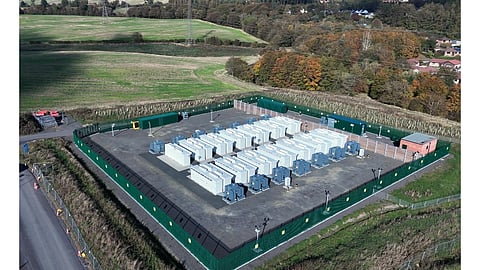


Batteries delivered 2.75 times as much energy to the all-island grid of Ireland during the first year of the new scheduling and dispatch programme
Battery supply during evening peak demand averaged 2.7%, up from 1.1% a year earlier
Batteries reached a peak grid supply of 520 MW on January 31, 2026, and increasingly charged during daytime hours between April and September 2026, according to EirGrid
Battery energy storage is starting to play a greater role in Ireland’s electricity supply, supported by regulatory framework. Following a scheduling and dispatch update to rules in November 2025, Irish grid operator EirGrid says there was a 2.75-fold increase in energy delivered by batteries to the all-island grid.
Between November 13, 2025, and November 3, 2026, batteries supplied an average of 2.7% of electricity demand during the evening peak period from 5 p.m. to 7 p.m., compared with 1.1% during the corresponding period a year earlier. This was an increase of 175% more energy delivered to the grid. Their contribution during this window reached a maximum of 9%.
Battery power supplied to the grid peaked at 520 MW on January 31, 2026, EirGrid reported. For context, EirGrid shared that the average peak demand in Galway is around 100 MW, about 83 MW in Drogheda, 75 MW in Limerick, and 69 MW in Athlone.
Battery charging patterns also shifted during the reporting period. Between April and September 2026, batteries charged more during the day than overnight, coinciding with periods of higher solar generation.
EirGrid attributes this to the successful implementation of changes under the Scheduling and Dispatch Programme (SDP-02) in November 2025, which enable batteries to participate more effectively in the electricity market.
The arrangements allow battery operators to respond more actively to electricity system requirements, increasing the energy they deliver to the grid. EirGrid said the ability to store electricity and discharge it when needed helps shift energy to periods when it is most useful to the power system.
The increase in battery utilization comes amid wider policy efforts to expand energy storage in Ireland. In June 2026, Ireland’s Minister for Climate, Energy and the Environment Darragh O’Brien shared that the country had installed over 800 MW of grid-scale battery storage since 2018. He stressed that grid-scale batteries place downward pressure on costs as these provide flexibility, reducing the dispatch down of renewables, while moving surplus electricity to times of higher demand.
The minister called the first year of EirGrid’s SDU for battery storage a successful one. He added, “Battery storage is now regularly contributing more than 400 MW of generation during evening peak demand periods, which is equivalent in scale to a large gas-fired power station, reducing costs for consumers and emissions for Ireland.”
Since October 1, 2026, Ireland’s CRU has eliminated grid connection charges on standalone and co-located battery energy storage systems (BESS). They will be required to pay Generation Transmission Use of System (G-TUoS) charges, consistent with those paid by wind and solar farms. This eliminates the payment of €30/MWh as Demand Transmission Use of System (D-TUoS) charges when importing electricity to charge.
Bobby Smith, the Director of Energy Storage Ireland (ESI) believes this reform will reduce balancing costs, curtailment and redispatch on the grid, while supporting increased integration of renewable energy.
A study by AFRY commissioned by ESI also examined the potential economic benefits of additional storage capacity in Ireland. In an early-2030s scenario in which renewable energy targets are met, the modelling found that 2 GW of additional six- to eight-hour storage could deliver net annual economic benefits of €102 million.
The study also modelled a high-gas-price scenario, in which the net benefit from the same additional storage capacity reached €151 million annually.