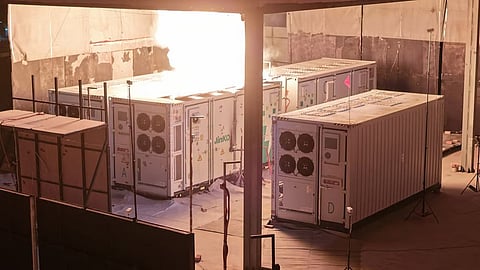

Jinko ESS has tested 4 SunTera 5MWh BESS in a high-density layout according to CSA C800 and the draft UL 9504A:2025 standards
The target BESS showed anti-deflagration properties even at 1,296°C peak cell temperature
The adjacent units keep their internal cell temperature within the thermal runaway thresholds with uninterrupted charging or discharging functions throughout the combustion period
Jinko ESS, a subsidiary and energy storage arm of JinkoSolar, has completed extreme fire testing on its containerized SunTera 5MWh battery energy storage system (BESS).
The company says this testing validates the performance of passive safety mechanisms in large-scale fire incidents, keeping other active features inactive and without manual intervention. This BESS, equipped with 314 Ah LFP cells and a liquid-cooling mechanism, boasts a nominal capacity of 5.015 MWh. It is designed to support continuous charge or discharge at a 0.5P rate, with an operational lifecycle of up to 20 years.
During testing, Jinko ESS deployed 4 BESS units to replicate a real-time high-density installation at a facility in Suzhou, Anhui Province. Keeping the target, Unit A, at the center, it places ‘Unit B’ in a back-to-back configuration with a 15 cm spacing. However, ‘Unit C’ and ‘Unit D’ were placed in a side-by-side and face-to-face configuration with a 1- and 3.5-m spacing, respectively. All units were charged to a 100% State of Charge (SoC) level with fire suppression functions kept inactive, to mimic a worst-case scenario.
According to the company, it started forced heating of ‘Unit A’ at 17:00 on February 10, 2026, with the cells reaching their ignition stage by 18:10. During this sustained combustion for up to 13 hours and 40 minutes, which ended at 07:50 on February 11, the internal temperature peaked at 1,296°C with enclosure doors closed and venting mechanisms engaged. The adjacent BESSs maintained their internal cell temperatures – Unit B at 51.3°C, Unit C at 38.3°C, and Unit D at 41.2°C – below their respective thermal runaway limits. The company notes that the external surface temperature of ‘Unit D’, closest to the originating unit, peaked at 404°C, while the internal cell temperatures remained within safe limits. These measurements validate the deflagration performance of the system and the thermal insulation and fire containment capabilities of the enclosure.
In addition to thermal insulation, these adjacent units maintained electrical functions, such as charging or discharging, without a reduction in performance throughout the testing period. Furthermore, the flue gases, originating during the combustion period, were captured and treated to minimize environmental impact.
This test procedure was conducted at a facility in Suzhou, Anhui Province, in accordance with CSA C800 and UL 9504A:2025 (draft) standards. The former refers to reliability and quality assurance of BESS, while the latter is a fire-safety testing framework developed by UL Solutions. In addition, the test results provide measured data for the Large-Scale Fire Testing (LSFT) framework referenced in the upcoming NFPA 855:2026 provisions. Jinko ESS adds that this evaluation test was witnessed by the representatives of CSA Group and North American fire protection engineers.
From the perspective of Carl Yang, Product General Manager at Jinko ESS, these test data help in guiding installation spacing to reduce the risk of multi-unit fire propagation. Patrick Rimel, North America Product Manager at Jinko ESS, also highlights that these quantifications of risks, which are becoming essential under LSFT, provide data-driven performance insights. These help insurers and project developers make permitting decisions and evaluate risks in high-density deployments. On the third-party certification agency side, Todd LaBerge, Fire Protection Engineer at ATAR FIRE, points to the incorporation of the deflagration-protection principle into the system, aligning with NFPA 68 and NFPA 69 standards.

