

Wood Mackenzie projects Latin America’s energy storage market to expand 13-fold between 2025 and 2035
Chile, Mexico, Brazil, and Argentina are emerging as key markets, supported by policy initiatives and tenders
It flags regulatory uncertainty, financing constraints, and unclear revenue mechanisms that could impede its growth
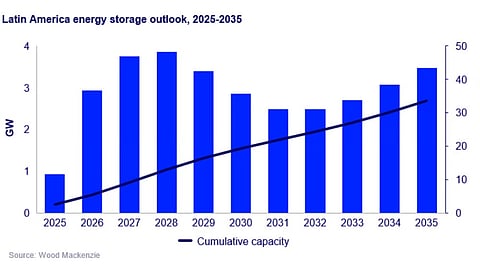
Latin America’s energy storage market is set for rapid growth over the next decade, with cumulative capacity projected to increase 13-fold to 34 GW by 2035, according to Wood Mackenzie. The market stood at 2.5 GW in 2025.
In its report Latin America Energy Storage Outlook 2026, analysts project a 30% compound annual growth rate (CAGR) through 2035. Wood Mackenzie said accelerating tender activity, rising renewable curtailment, and aging transmission infrastructure are driving the expansion.
Chile is leading the region with the largest operational battery energy storage system (BESS) projects. The push for longer duration energy storage comes from high curtailment. Analysts at the market intelligence firm highlight price cannibalization as an emerging market risk.
Another big market that Wood Mackenzie identifies is Mexico. Two mechanisms – the first priority call for proposals and a joint development call with the Federal Electricity Commission – include mandatory storage, which gives a boost to this technology. Both these measures are expected to award more than 3 GW of storage capacity by 2030.
Brazil is also expected to see a step-up in storage deployment, mainly driven by a dedicated battery tender scheduled for December 2026. It is expected to drive capacity additions from 2028. Wood Mackenzie said project financing could remain difficult in the near term without clear remuneration mechanisms.
Argentina is another promising market that has already used tenders to develop a standalone storage market. Recent rounds awarded a combined 1.3 GW of standalone storage, with operations scheduled to begin in 2027 to support transmission.
In the Caribbean, the Dominican Republic has the most structured regulatory framework, according to Wood Mackenzie. A mandate requiring storage equal to 50% of solar capacity is supporting near-term deployment. The government target is to achieve 500 MW capacity by 2030.
“Latin America is no longer a frontier market for energy storage, it is an active one,” said Pamela Morales at Wood Mackenzie. While the project pipeline is growing quickly, deployment could stall without comprehensive regulatory frameworks and clear remuneration mechanisms, she points out.
Despite the projected growth, regulatory and financial barriers remain, as the report writers point out. Financing restrictions, permitting delays and limited offtakers are among the challenges listed, along with a lack of defined remuneration for ancillary services and energy arbitrage.
“Latin America still needs to find a balance between mandates and incentives to develop the market,” Morales said. She added that countries with bankable revenue frameworks would be better positioned to attract investment and sustain growth beyond the current policy-driven phase.
