
QAES launches its latest Direct Immersion-cooling Luminary Nova-781 series ESS for Europe’s C&I applications
The company claims that its circulating cooling mechanism helps maintain real-time cell-to-cell temperature variance below 1°C
This ESS is expected to be commercially available in Q1 2027
QAES, a China-based energy storage system (ESS) provider, unveiled its latest Direct Immersion-cooling Luminary Nova-781 series cabinet-based product at Intersolar Europe 2026. The company promotes this product for commercial & industrial (C&I) applications.
The company emphasizes thermal management as one of this system's key features.
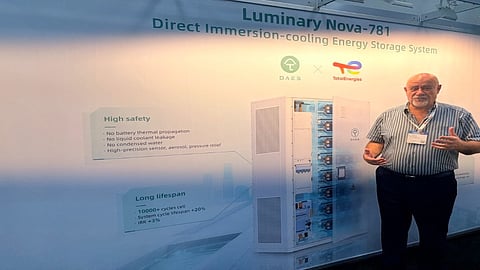
It immerses its battery stacks directly in a proprietary dielectric liquid with good thermal conductivity, unlike conventional liquid-cooled C&I ESSs that use a mixture of ethylene glycol + deionized water as coolant. The liquid, pumped across the battery surfaces, absorbs heat directly rather than via a plate or pipes, helping to maintain cell-to-cell temperature delta within 1°C. The warm liquid then passes through a heat exchanger or chiller to cool and reuse it. The company claims that this active thermal balancing reduces internal losses and helps in conserving additional charges, leading to a DC round-trip efficiency (RTE) gain of more than 2%. The RTE of an ESS is a measure of how little energy is lost during charging/discharging cycles. This improvement also limits battery aging and supports more than 10,000 cycles. According to the company, it also improves system cycle lifespan by more than 20% compared to conventional alternatives. This coolant is supplied by TotalEnergies, a French multinational integrated energy and petroleum company.
On the safety side, the dielectric coolant isolates the immersed battery cells from oxygen, even in the event of thermal runaway caused by an internal short circuit. As a result, it eliminates battery thermal propagation at the source. Compared to conventional C&I counterparts, it also prevents leakage through pipes. Despite these inherent safety features, the cabinet is equipped with sensors that detect and send a fault signal in case of any abnormalities. In addition, if the first line of defense fails, its aerosol-based fire suppression system and pressure relief valve are activated.
In terms of performance, this system features 8 battery packs, each mounted on the other and consisting of 587 Ah lithium-iron-phosphate (LFP) battery cells. Measuring 2,100 × 1,400 × 2,415 mm (L × W × H), this ESS is rated for up to 781 kWh of storage capacity at a DC bus voltage of 1,331 V. For AC coupling, it can connect to an external bidirectional power conversion system (PCS), aligning with the user’s full-load demands and voltage range (AC side). Given that many European regions experience cold ambient temperatures for most of the year, the system is rated for a wide operational temperature range of -25 to +55°C.
The ESS can be coupled with PV capacity in an AC- or DC-coupled configuration to make a collocated PV + ESS system. It also supports grid-forming-compatible PCS and can participate in grid ancillary services, such as virtual power plant (VPP) aggregation. For energy trading market participation, the system can automatically charge at low prices and discharge to the energy market at high spot prices, enabling energy arbitrage.
According to the company, this product is scheduled to be commercially available in Q1 2027.

