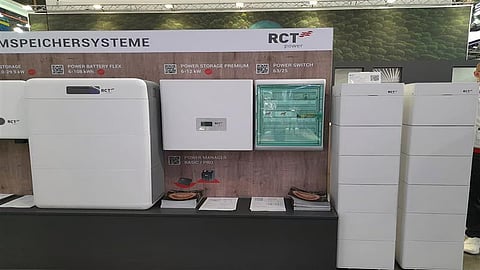

RCT Power showcased its latest POWER STORAGE PREMIUM series 12 kW hybrid inverter at the show
This inverter is designed to combine solar, storage, and grid in a DC-coupled configuration
It is expected to be commercially available in Q4 2026
The core component of an integrated residential energy storage system (ESS) is its hybrid inverter, which combines multiple energy sources, such as solar, storage, and grid, on a unified platform to maximize PV self-consumption. It can be integrated with storage in a single cabinet or sold individually to customers.
Taking the latter route, RCT Power GmbH, the energy storage arm of RCT Group, highlighted its new hybrid inverter, POWER STORAGE PREMIUM, at Intersolar Europe 2026. The product is aimed at Europe’s behind-the-meter (BTM) residential and small commercial prosumers.
In terms of design, it consists of MPPT channels to couple with PV sources, while the dedicated battery ports are used to connect to a suitable storage platform. At the same time, 3 different types of energy sources are integrated when the hybrid system’s output is coupled to the AC grid.
The inverter is equipped with 2 MPPTs, each rated at 16 A, and can connect to a south-facing PV array of up to 16.2 kW, or 18 kW for east-west orientation. An intermittent DC-DC converter maintains the real-time MPPT voltage within a rated range of 140 to 950 V and feeds the DC busbar, which connects to a bidirectional inverter. At the storage end, unlike the conventional system that features a bidirectional battery inverter between the grid and storage, it directly connects the latter to the common DC busbar. According to the product datasheet, it is rated for a maximum battery charge/discharge current of up to 25 A within a voltage range of 120 to 650 V, with corresponding charge and discharge powers of 11.52 and 12 kW, respectively.
During daytime operation, the system automatically prioritizes the solar source over storage and feeds the inverter via the common busbar to deliver a full-load AC power of 12 kW. It diverts excess solar energy to storage via the busbar, thereby maximizing solar harvesting. However, the storage fulfills its remaining charging needs from grid sources during low solar generation or at nighttime. These complex cycles of charging and discharging can be automatically monitored and controlled by its built-in energy management software. It can also deliver demand- or weather-forecast-based battery charging to optimize energy management. In case of a grid outage, the system, in conjunction with an external power transfer switch, RCT Power Switch, goes into off-grid mode and delivers emergency backup to the house or small commercial loads.
The company claims a maximum PV-to-AC conversion efficiency of 98.6% for this inverter, attributing it to its DC-coupled architecture.
RCT plans to commercially launch this inverter by Q4 2026, accompanied by a 5-year product warranty.

