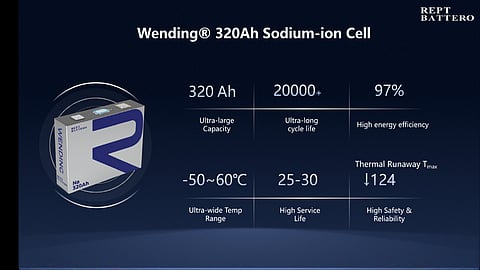

REPT BATTERO unveiled its 320 Ah Na-ion battery cell, which has a guaranteed life of more than 20,000 cycles
It has a lower peak thermal runaway temperature than its LFP counterparts, reducing the risk of fire or explosion at fault occurrences
This battery is suitable for cold regions, off-grid, and long-duration backup applications
REPT BATTERO Energy Co., Ltd., a China-based cell and battery energy storage system (BESS) maker, introduced its latest products for medium- to long-duration energy backup at Intersolar Europe 2026. The company says these products meet Europe’s local site conditions.
Beyond conventional lithium-iron-phosphate (LFP) battery cells, the company launched its latest sodium-ion (Na-ion) chemistry-based product for long-duration energy backup. It features a customized cathode and hard carbon-based anode. During charging/discharging, Na-ions flow between the cathode and anode via the electrolyte solution. It has a rated capacity of 320 Ah. In terms of form factor, it uses a proprietary Wending structural design. According to the company, the product combines these attributes to achieve low loss between each cycle, with a round-trip efficiency (RTE) of more than 97%. In addition to this key performance indicator, it has a guaranteed life of more than 20,000 cycles, corresponding to a service life range of 25 to 30 years.
At the same time, it is designed to operate within a wide ambient temperature range of -50 to +60°C, ensuring the flow of Na-ions in extremely cold weather. The company claims that it can retain up to 87% of its rated capacity in extreme freezing conditions across Europe.
In terms of operational safety, this battery cell has a lower peak thermal runaway temperature of 124°C, compared to its LFP counterparts. Thermal runaway occurs when a battery’s internal temperature increases to a point where it triggers a self-sustaining reaction that continues to raise the temperature. This extreme scenario eventually causes the battery to vent, catch fire, or even explode. The causes of this failure mode are internal battery short-circuits, overcharging, and mechanical damage, among others. The company noted that this new Na-ion battery cell passed in-house nail penetration, overcharging, and thermal abuse tests without fire or explosion.

