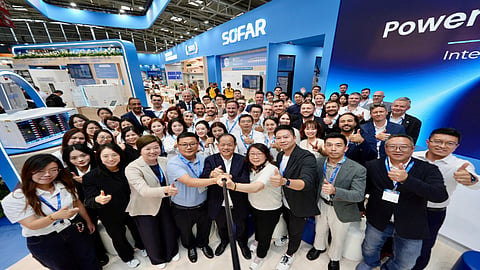

SOFAR Solar promoted its PowerEasy series 120 kW/256 kWh residential ESS for front-of-the-meter applications
The company also showcased its 125 kW/261 kWh PowerMagic 2.0 and 0.25 MW/1 MWh PowerMagic Cube series C&I ESS
Among the displays was a utility BESS, called PowerMaster 2.0
SOFAR Solar Co., Ltd., a PV inverter and energy storage system (ESS) provider, participated in Intersolar Europe 2026 with its product lineup covering residential, commercial & industrial (C&I), and utility applications.
The company promoted its PowerEasy series residential ESS, consisting of the HYD-20K-LT1 series 3-phase hybrid inverter and the SF-16KWH-L1 series lithium-iron-phosphate (LFP)-based battery packs. The inverter is rated for 20 kW of full-load power and is AC-coupled to a 64 kWh LFP battery stack, consisting of 4 battery packs (mentioned above). Each 16 kWh battery pack is mounted on the other. For capacity expansion, up to 6 inverters and 6 battery stacks can be connected in parallel, making a 120 kW/256 kWh ESS platform for small-scale commercial or large residential prosumers. It also supports a new or existing PV array to maximize self-consumption of clean power. The ESS’s built-in battery management system (BMS) monitors and measures battery voltage, current, and temperature to predict the system’s real-time state of charge (SoC). From a real-time operational perspective, it delivers emergency backup during a grid outage, optimizes energy costs by shifting to time-of-use (ToU)-based consumption, and participates in energy arbitrage. All these complex operations are automatically initiated by a built-in energy management system (EMS) and performed according to its embedded algorithms.
For C&I applications, the company showcased its cabinet-based PowerMagic 2.0 and containerized PowerMagic Cube series ESS. Part of the PowerMagic 2.0 series, the ESS-261 KLC-SA1 combines battery stacks, EMS, BMS, and a power conversion system (PCS) within a single cabinet. Equipped with 5 battery packs, each mounted on top of the other, the ESS has a rated storage capacity of 261 kWh. A bidirectional 125 kW 3-phase PCS, which charges and discharges the battery from and to the grid, is placed at the bottom of the cabinet. In terms of applications, this125 kW/261 kWh ESS features grid-forming technology and can participate in multiple types of grid ancillary services.
The PowerMagic Cube is housed in a container that looks like a cube. It is equipped with 1 MWh of storage capacity and is integrated with PCSs. According to the company, its backup duration can vary between 2-, 4-, 6-, and 8 hours, depending on the PCS’s capacity during a grid outage or ancillary services. In general, its rated capacity is 0.25 MW/1 MWh. For thermal regulation, the battery stacks are cooled round-the-clock by a circulating liquid coolant, while the PCS is cooled by built-in fans. Its EMS is programmed for multi-scenario applications, such as maximizing self-consumption, emergency backup, and rapid demand response. It can also be suitable for microgrid or off-grid operation. On the safety side, it is equipped with cell, battery pack, and system-level fire protection and suppression systems. The container also has a directional gas exhaust system and explosion vents for forced ventilation of excessive buildup pressure, ensuring multi-dimensional safety against battery thermal runaway.
The company also promoted its PowerMaster 2.0 series BESS for utility applications. It has a system capacity of 5.16 MW/10.32 MWh. The company didn’t reveal much about this product at the event.

