
Sungrow’s latest DC-coupled system combines the Matrix inverter, MPPT booster, and ESS
Its multi-path redundancy architecture isolates faults at the node level, continuing system operation at unaffected sections
For grid ancillary support, its source-level grid-forming capability contributes to voltage stabilization and synthetic inertia compensation
PV plus energy storage systems (ESS) provider Sungrow introduced its latest system-level DC-coupled architecture at the Global Renewable Energy Summit (GRES) 2026.
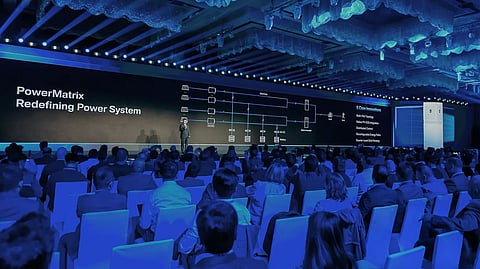
PowerMatrix
Unveiling the PowerMatrix system, the company emphasized the matrix-like integration of PV, storage, and other power sources on a single platform. This comprises the newly launched Matrix inverter, MPPT booster, and the ESS (PowerTitan 3.0 series). Unlike the AC-coupled system, where PV generation, storage, and grid-support functions are typically handled through separate stages, this DC-coupled system unifies the architecture. Each direct DC interconnection between the PV array and the ESS, which acts as a node, forms a distributed power matrix.
On the PV side, it incorporates an MPPT architecture with a density of 28 channels/MW, reducing mismatch losses, orientation differences, and module aging. While it does not provide the rated DC/AC overload capacities, the company noted that the MPPT features a booster circuit to maximize solar harvesting. The connected ESSs can charge or discharge the stored energy for up to 3,000 cycles. In addition, this direct PV-to-storage charging reduces multi-stage power conversion and improves energy transfer efficiency by up to 5%. It also increases usable storage capacity by up to 8% through cell-to-plant state-of-charge (SOC) balancing, claimed Sungrow.
In terms of grid operations, this multi-path redundancy architecture isolates faults at the node level, allowing system operation at unaffected sections. In addition, each sub-array within the system can function as an independent solar-plus-storage unit with grid-forming capability. As a result, each node contributes to voltage and frequency stability for both grid-connected and islanded operation. The company claimed that it possesses voltage-stabilization and inertia-response capabilities of <10 ms and <5 ms, respectively.
The company cited the example of a 1 GW PowerMatrix system featuring 8 GWh ESS (up to 3,600 cycles) to illustrate its advantages over AC-coupled peers. It claims a total CapEx reduction of approximately $120 million, attributable to savings in substation infrastructure, cabling, and ESS equipment, among other areas.
According to the company, this system-level architecture is designed for multiple applications, such as utility, commercial & industrial (C&I), mining microgrids, and AI data centers.
Lee Zhang, VP of Sungrow and President of its Utility PV Inverter Business Unit, said the company aims to support the industry’s transition ‘from standalone equipment integration to deeply coordinated system design’.

