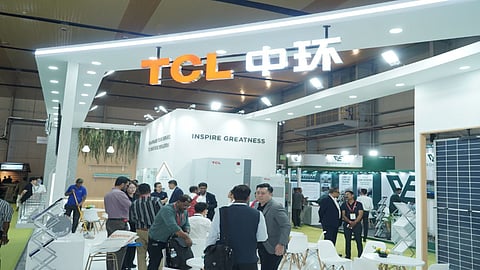

TCL Zhonghuan showcased its BlueArk X1 single- and 3-phase ESSs for residential users
It also promoted its BlueArk X5 and BlueArk W10 ESSs for C&I use cases
The former is rated at 50 kW/100 kWh and adds an external hybrid inverter, while the latter combines a 125 kW PCS and 261 kWh storage in a single cabinet
Vertically integrated PV manufacturer TCL Zhonghuan, which recently entered the energy storage system (ESS) space, highlighted its BlueArk series residential and commercial & industrial (C&I) ESSs at REI 2026.
The BlueArk X1 residential ESS is available in two categories: single- and 3-phase. It integrates a hybrid inverter, batteries, and an energy management system (EMS) within a single platform. The product datasheet specifies a rated full-load power range of 3 to 8 kW (single-phase, 220/230/240 V) and 5 to 16 kW (3-phase, 380/400 V) for hybrid inverters. The single- and 3-phase inverters, equipped with three MPPTs, support 200% PV overcapacity relative to rated full-load power, with corresponding PV capacities of 6 to 16 kW and 10 to 30 kW, respectively. This oversizing helps to maximize PV harvesting. The inverter supports up to four 8 kWh LFP batteries, each rated at 314 Ah and stacked on top of each other, for a total capacity of 32 kWh. This storage is charged through the PV source (priority) and the grid. Measuring 780 × 270 × 260 mm (W × H × D), each battery has a rated charging/discharging power of 4 kW, an operating temperature range of -20 to +55°C, and an IP66 rating. All models switch to backup mode within 10 ms of a grid outage and deliver a full-load backup power range of 6 to 8 kW (single-phase) and 5 to 16 kW (three-phase). The single-phase ESSs also support external diesel generator sets, ranging from 4.2 to 11.5 kW. In comparison, all three-phase variants support a 22 kW DG set. In terms of rated maximum conversion efficiency, single- and 3-phase models are rated at 97.6 to 98.1% and 97.8 to 98.2%, respectively.
The company also showcased its BlueArk X5 and W10 ESSs for C&I applications. The X5 series is equipped with 100 kWh LFP batteries in an IP55-rated cabinet. A 50 kW hybrid inverter (3-phase) is also fixed on the side wall of the cabinet. This inverter, with six MPPTs rated at 45 A and a voltage range of 180 to 850 V, supports up to 100 kW PV capacity. The W10 ESS combines a 261 kWh LFP storage section and a 125 kW PCS in a 1,000 × 2,355 × 1,350 mm cabinet. Unlike the X5, it doesn’t support direct PV connection. Both ESSs shift to emergency backup mode within a few ms of a grid outage and deliver a full-load power output of 55 kVA (X5) and 125 kVA (W10). The X5 uses forced air-cooling for its inverter and heating, ventilation, and air conditioning (HVAC) for its storage section. However, the W10 series employs a liquid-cooling system for thermal regulation. The press release says the X5 ESS, which connects to a 138 kW DG set, supports coordinated PV + DG operation in remote areas or industrial parks with unreliable grid connections.
