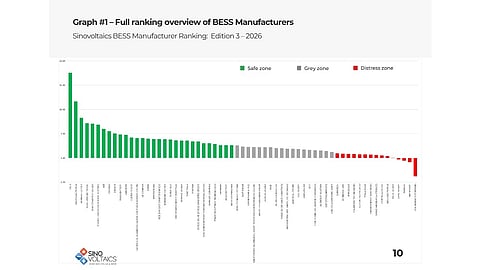


Sinovoltaics says while more manufacturers have moved into the financial ‘safe zone’ in its ranking since 2023, a significant number remain at elevated financial risk
Diversified industrial companies continue to outperform businesses solely focused on battery, solar, or storage segments
While several companies improved their financial scores, some storage-focused firms remain in severe financial distress
US-based Tesla, Taiwan's Delta Electronics, and South Korea's Hyundai Electric ranked as the three most financially stable energy storage manufacturers in Sinovoltaics' latest BESS Manufacturer Ranking Report.
The report assesses 65 battery energy storage system (BESS) manufacturers, OEMs, and system integrators using the Altman Z-score financial health model, covering the period from September 2023 to June 2026.
The report's authors found that financially diversified industrial suppliers continue to outperform businesses focused on a single product segment, widening the gap between the two groups.
According to the report, 30 companies are now in the Altman Z-score ‘safe zone’ with scores above 2.6, compared to 26 at the beginning of the tracking period. Another 18 companies fall in the ‘grey zone’ with scores between 1.1 and 2.6, while 17 companies remain below the 1.1 threshold associated with a higher bankruptcy risk over the next two years. Of these, six recorded negative scores, indicating severe financial distress.
Sinovoltaics says diversified industrial and energy management companies, including Tesla, ABB, Delta Electronics, Eaton, Siemens Energy, and GE Vernova, recorded an average Z-score of 5.54 during the latest quarter.
Inverter and power conversion system manufacturers averaged 3.26, landing in the safe zone, while battery cell and pack makers scored 2.03, placing them in the grey zone.
Solar module manufacturers averaged 1.13, just above the higher-risk threshold, and standalone energy storage integrators posted the weakest average score at 0.08.
The report identified Tesla, Delta Electronics, Hyundai Electric, Kung Long Batteries, Zhongtian Technology, Sinexcel, ABB, Generac, EnerSys, and Yuasa Battery as the top 10 companies in the latest ranking.
Among storage integrators, Eos Energy Enterprises, Stem Inc., and ESS Tech recorded negative Z-scores. ESS Tech posted the sharpest decline in the ranking, while GE Vernova, Hyperstrong, and SolaX Power improved from near-zero scores to the safe zone. Eos Energy Enterprises also improved its score despite remaining in the severe distress category.
“What we're seeing is a maturing market rewarding balance-sheet depth over pure growth,” said Arthur Claire, Director of Technology at Sinovoltaics. “Companies that diversified beyond a single product line are compounding that advantage, while suppliers exposed to one segment, whether that’s cells, modules or storage integration, are absorbing the full force of the current margin compression.”
Sinovoltaics said the rankings are intended to help project developers, EPC contractors, investors, and procurement professionals assess supplier financial stability and long-term warranty risk for BESS projects.
Details regarding the report are available on Sinovoltaics’ website.
