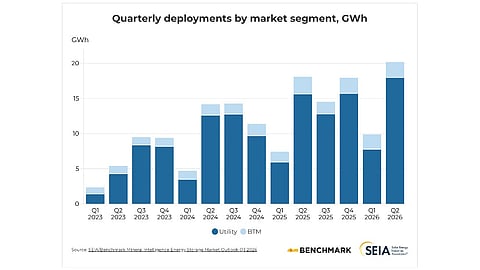


A new report on the US energy storage market shows utility-scale projects accounted for most of the record quarterly deployment in Q2 2026
Residential storage faced a sharp annual decline even as C&I demand strengthened
The latest outlook points to continued growth through 2026, alongside expanding US battery manufacturing capacity
A surge in large battery projects pushed the US energy storage market to its strongest quarter on record in Q2 2026 with 20.2 GWh/6.7 GW capacity, while residential installations moved in the opposite direction.
The country’s utility-scale storage capacity nearly doubled from 88 GWh to 165 GWh in the first 18 months of the Trump administration.
According to the US Energy Storage Market Outlook Q3 2026 from the Solar Energy Industries Association (SEIA) and Benchmark Mineral Intelligence, the US battery energy storage system (BESS) market expanded by 11% year-on-year (YoY) in the reporting quarter.
This brought the country’s H1 2026 installations to around 31 GWh/10.3 GW, up 23% YoY. Utility-scale projects led the total, accounting for 26 GWh/8.1 GW, with 10 states adding more than 500 MWh of new capacity. In Q1 2026, the US added 9.7 GWh of capacity (see US Energy Storage Market Posts Record Q1 2026).
Battery energy storage supplied more electricity to the grid in the first eight months of 2026 than in all of 2025, according to the report, helping provide power to states during periods of extreme heat.
SEIA President and CEO Tim Pawlenty said, “This record growth highlights that storage is a powerful reliability tool that strengthens our energy security, meets rising demand and puts downward pressure on electricity bills.”
Utility-scale storage accounted for 18 GWh of the 20.2 GWh deployed during Q2. Arizona, California, Utah, and Texas each added more than 2.5 GWh during the quarter. Seven projects with capacity of at least 1 GW came online, including four in Arizona, two in California, and one in Utah.
The report shows that 56% of utility-scale capacity additions were standalone storage projects, while 44% were paired with solar. Arizona recorded 6.2 GWh of new storage installations, the highest quarterly total for any state, according to analysts. Texas and California followed with 3.8 GWh and 3.6 GWh, respectively.
The market is also becoming more geographically diverse as the report shows strong pipeline growth emerging in states including Arizona, Nevada, Oregon, and Colorado. Benchmark says this indicates that deployment is expanding beyond the markets that have historically dominated storage activity.
Residential battery storage remained under pressure in Q2 2026, with installations totaling 657 MWh, down 27% from a year earlier. Analysts attribute the decline partly to the removal of the 25D incentive and the surge in installations during the previous year as projects were brought forward ahead of the incentive change.
As a result, residential deployments reached 894 MWh in Q2 2025, fell to 599 MWh in Q1 2026, and rose slightly to 657 MWh in the reporting quarter. Despite the near-term decline, the report says higher electricity costs, changes to net metering, greater concerns about outages, and state-backed virtual power plant (VPP) and demand-response programs could support residential storage over the longer term. In 2026, this segment will likely see installations declining by 16% YoY to 2.68 GWh.
Commercial and industrial (C&I) storage continued to grow, with 1.8 GWh deployed in Q2. The report links much of the market's development to the expansion of data centers and the challenge of securing sufficient grid capacity. It says developers are increasingly considering ‘bring your own generation’ models that combine batteries with on-site or co-located solar and wind.
Battery systems can be used to shift renewable generation, respond to rapid changes in data center demand and provide short-duration backup. Uninterruptible power supply systems are also being used to address power-quality requirements. However, pairing natural gas with storage in some hybrid configurations has drawn criticism because of its environmental impact.
Benchmark expects total US BESS installations to reach 71 GWh in 2026, compared with 59 GWh in 2025, representing 20% annual growth.
SEIA said the latest market outlook also raised its forecast for US energy storage capacity through 2030 by 11.5% to 683 GWh, reflecting stronger-than-expected demand. “The upward revision comes as the industry continues to set deployment records, with more than 10% of all energy storage capacity currently installed in the U.S. coming online in Q2 alone,” stated the association.
The storage market's growth is also coinciding with additional US manufacturing capacity. The report highlights Tesla's first Megapack units built with domestically produced lithium iron phosphate (LFP) cells and the start-up of its third Megafactory in Texas, which has a planned annual nameplate capacity of 50 GWh.
Overall, the planned North American BESS manufacturing capacity has now exceeded 250 GWh, with LG Energy Solution (LGES) expected to have 44 GWh of planned nameplate capacity by the end of 2026. According to the report, this will make LGES the largest player in nameplate capacity as it expands its total capacity to exceed 100 GWh by the end of 2030.
The report also notes that L-H Battery Company, a joint venture of LGES and Honda Motor, began producing battery cells at its completed facility in Jeffersonville, Ohio, for stationary energy storage applications. Samsung SDI, meanwhile, plans to begin US production of prismatic LFP cells in October 2026.
The complete report is available for purchase on Benchmark’s website.
