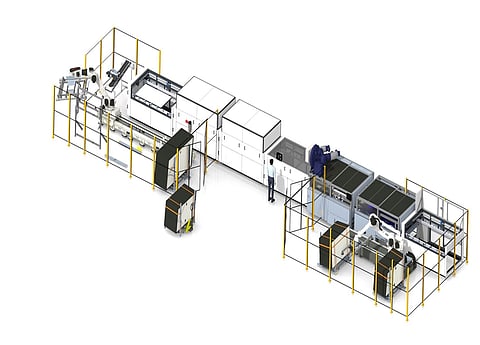

2nd Cycle’s fully automated module reuse line screens used modules for structural, electrical, and material-related defects
AI-based imaging, dark IV, EL, insulation, and leakage tests are part of the evaluation process
Each module receives a unique identifier linking it to its test results and images
Photovoltaic module recycling has been the industry buzzword and is now trending, with several equipment manufacturers offering turnkey lines. However, module upcycling, or reuse, is still relatively new. Austria-based 2nd Cycle offers a fully automatic module reuse line that evaluates end-of-life or discarded modules and, if they pass, gives them a new life.
The module evaluation starts with the company’s SolarBox, a reusable transport box that keeps a module safe on its way to the reuse facility. The box is also compatible with robotic handling. The first step is automated module measurement using a 2D image recognition platform, followed by nameplate identification, where the module’s original parameters are automatically recognized from the label. At the next station, the module is cleaned with water and brushes.
After cleaning, the module is first visually inspected for cracks, fractures, burn marks, delamination, corrosion, discoloration, and other frame- and junction box-related defects. This is done by capturing images of the module from various angles using multiple cameras and analyzing them with AI-based image analysis software. Modules with critical defects such as heavy glass damage are screened at this step. The module is then passed through dark IV measurement (IV without illumination) to assess cell condition and identify potential defects by analyzing the behavior of current at various externally applied voltages.
The next step is electroluminescence (EL) imaging, which identifies defects such as microcracks, scratches, breakage, soldering defects, etc. Following EL imaging, the module is tested for leakage current under moisture conditions according to IEC 61215-2 (MQT 13). The module is also tested for insulation under high voltage to ensure there is no electrical hazard during its second life.
The module’s encapsulants and backsheet are also evaluated in the reuse line: under UV light, the EVA fluoresces, and the fluorescence pattern is captured to reveal its aging condition and microstructures hidden to the naked eye. This test can identify EVA discoloration, delamination, air inclusions, and mechanical stress in the encapsulant. Near-infrared (NIR) spectroscopy is also conducted to understand the backsheet material composition. This not only identifies material types but also provides insights into recyclability.
After these tests, the module undergoes a flash test that records the module’s IV characteristics under illumination and determines the module’s power output. A bypass diode test is also conducted to identify diode faults that might cause heating during module operation.
Finally, the module is assigned a QR code and a unique identifier, linking all test results and images so the module is traceable. 2nd Cycle says an upcycling system can process about 300,000 used modules with a 70% reuse rate, equivalent to saving 7,350 tons of PV waste and preventing 3,675 tons of CO2 emissions.

