
Key takeaways:
ConfirmWare’s AMS120CA combines non-destructive cell slicing with tabbing and stringing in a double-lane CTS configuration
The platform supports multiple interconnection approaches, including BC compatibility, multi-cut cells, and optional 0BB upgrades
Rated throughput reaches up to 12,000 half-cell slices per hour, with integrated inspection and MES connectivity for production monitoring
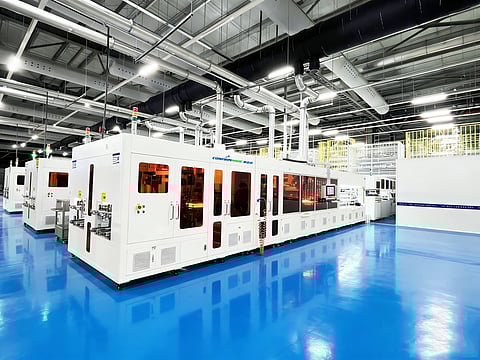
For the TaiyangNews Market Survey on Solar Module Production Equipment 2026, ConfirmWare has provided data for its 2024 model, which it calls Ultra-High Speed MBB Cell Stringer NDC AMS120CA. The stringer comes with 2 special features. Firstly, the system integrates cell slicing via a non-destructive cutting method, denoted by ‘NDC’ in its model name. The integration is beneficial for module makers with no upstream integration. Secondly, the platform also supports the interconnection of back contact (BC) cells. The platform supports several busbar layouts and allows shifting between them in less than 4 hours. It can also be upgraded to a zero-busbar (0BB) flexible interconnection configuration.
It is designed to operate in a double-lane configuration, where tabbing and stringing are performed simultaneously. For soldering, this model uses IR heating with adjustable temperatures from 100°C to 350°C, enabling the tool to be used for HJT in addition to TOPCon and PERC.
It uses a conveyor belt to transport cells and strings, and supports post-stringing inspection via standard EL testing with optional PL, VI, AOI, and appearance inspection integration. The layup interface consists of 2 automatic layup transmission lines, each capable of processing 83 strings of 144-cell panels (12 strings/panel) per hour with 144 cells per string.
The system integrates with manufacturing execution system (MES) platforms and application programming interface (API) detection systems via standard data interfaces. AMS120CA measures 12,217 mm in length, 2,550 mm in width, and 2,300 mm in height, with a total weight of 16,200 kg.
The tool comes with semi-automatic cell loading as standard, with an upgradable option for fully automatic loading. The system includes 16 material cassettes, each capable of holding up to 300 full cells. The AMS120CA supports cell sizes from 156 mm to 230 mm, cell thicknesses from 110 µm to 200 µm, and a range of 3 to 24 busbars. The tool handles half-cells, 1/3 cells, 1/4 cells, and other rectangular wafer formats. The stringer uses round ribbon with diameters between 0.20 mm and 0.32 mm with mechanical properties including elongation ≥25%, yield strength of 70-80 MPa, and a minimum tensile strength of 150 MPa. ConfirmWare recommends using ribbons with tin-lead alloy coating applied via hot-dip. The tool is compatible with both round wires and irregular-shaped ribbons.
Before soldering, flux is applied using a ribbon immersion method. The maximum string length supported is 1,300 mm with customizable options. Cell spacing is adjustable from 0.8 mm to 6 mm, or -1 mm to -0.4 mm, depending on the interconnection type. Negative spacing supports overlapping designs, such as shingling.
After cell interconnection or stringing, defects are identified using a vision inspection system. Detectable defects include missing corners, broken edges, cracks, 90° or 180° rotations, and foreign matter on the surface. Cell alignment uses visual positioning with ±0.1 mm accuracy, while ribbon placement relies on mechanical positioning with ±0.3 mm center-line deviation accuracy on both front and rear busbars.
The rated throughput of AMS120CA, based on half-cells, is a maximum of 12,000 slices per hour and an average of 11,000 slices per hour. It has an annual production capacity of approximately 300 MW. ConfirmWare claims mechanical and process yields of 98% for AMS120CA, and a system uptime of at least 95%.
The soldered cell has an assured peel strength of 0.8 N on both cell sides, with the allowance for one solder point per front-side busbar below 0.8 N. Note that these peel strength values correspond to the overall ribbon adhesion strength all along the length of the busbar at the points of soldering, i.e., the soldering is not continuous. ConfirmWare assures that no more than 1 soldering point would have a peel strength of less than 0.8 N per busbar.

The text is an edited excerpt from TaiyangNews’ latest Market Survey on Solar Module Production Equipment 2026, which can be downloaded for free here.
