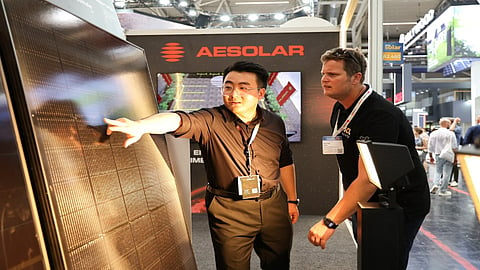

AESOLAR unveiled its ShadeStar series segmented PV module for permanent rooftop partial shading scenarios
The company also displayed its Terra series agrivoltaic application modules for elevated and vertical installations
The company’s Horizon series carport application module was also in focus
At Intersolar Europe 2026, AESOLAR, a well-known German PV module maker, showcased its product range for various applications, including permanent rooftop partial shading, agrivoltaics (agri-PV), vertical installations, and carports.
The highlight of the company’s booth was its newly launched ShadeStar module, designed for European rooftops.
For some background on its applicability, rooftop installations, which are often partially shaded by permanent structures such as chimneys, can’t reach their rated power during periods of shading. This can be partly addressed in two ways. The first is by using an external power optimizer, which enables real-time module-level power optimization, but its MPPT-level optimization can’t take advantage of the unshaded parts of the affected sub-strings. The second is to use a BC module, which often bypasses shaded cells with a lower reverse breakdown voltage characteristic, but its frequent on/off cycling reduces the cells’ long-term durability.
Addressing these challenges, the ShadeStar module features 80 G12 TOPCon half-cut cells, which are segmented into small groups. It is equipped with flat-type active and passive bypass diodes embedded in the lamination stack. According to the company, in case of partial shading, passive diodes provide segment-level protection, while active diodes reduce heat generation and power losses. During field testing by Fraunhofer CSP, this module outperformed its TOPCon and BC counterparts under different shading scenarios. The module generated additional energy while reducing substring-mismatch losses and preventing hotspot risks, thereby eliminating the need for an external optimizer, the company stated. On the performance side, this monofacial module, measuring 1,762 × 1,133 × 33 mm, can deliver up to 440 W of power and up to 22.04% efficiency. Recently, Hamed Hanifi, Director of Technology and Innovation at AESOLAR, explained this module’s shade-resistant behavior under different scenarios at the TaiyangNews Global PV System Technology Trends H1/2026 virtual conference.
For the dual use of Europe’s farmlands, the company also displayed its Terra series of modules for elevated and vertical installations. The Terra E series double-glass bifacial module, featuring 96 half-cells, offers up to 40% transparency. It is rated at 395 W of power and 13.05%. Therefore, when mounted on an elevated structure, this module provides balanced sunlight while generating power for captive use.
AESOLAR pitched its Terra V series module for applications such as sound barriers, solar fences, and agri-PV. Equipped with 2 mm front and rear glass along with POE-based encapsulation, this 1,190 × 2,282 × 30 mm module is built for vertical installations. Compared to a conventional half-cut cell-based module, the long sides of 144 half-cut cells are aligned with the module’s long side, improving dynamic mechanical load resistance. In terms of performance, it is rated for a maximum power of 580 W and an efficiency of 21.36%.
The company’s carport application module, Horizon, was also in focus at the exhibition. This module features 108 half-cut TOPCon cells, with 2 mm front and rear glass and a POE encapsulant. It can deliver up to 440 W of power and achieve up to 22.57% efficiency. It is certified by the German Institute for Construction Technology (DIBt) for safety, durability, and compliance in building-integrated applications.
According to the product datasheets, the above-mentioned modules carry a product and performance warranty of up to 30 years.

