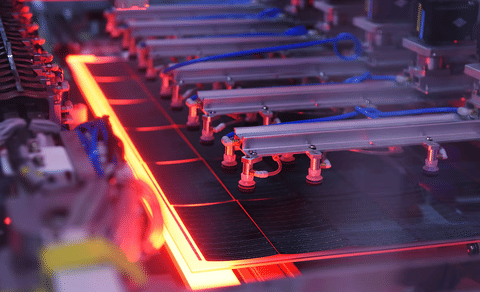


AIKO increases ABC module efficiency to over 25%, reaching 675 W output power
Improvements combine passivation, 0BB metallization, and full-screen module integration
Production and shipments ramped rapidly from late 2025, peaking at shipments of 385 MW in February 2026
There is a renewed focus on efficiency in the PV industry, evidenced by solar modules reaching record efficiency levels. Efficiency gains are increasingly coming from combined improvements across cell and module design rather than a single technological change.
AIKO’s All Back-Contact (ABC) module has achieved a rated efficiency of 25%, as reflected in the April 2026 edition of the TaiyangNews TOP SOLAR MODULES listing. The A-MDE72Mw (Comet 3N72 series) achieves this efficiency with a power output of around 675 W. The module is based on an n-type ABC cell architecture and a 144 half-cell (6×24) layout. It uses a mono-glass configuration with a full-screen design and shingled interconnection, supporting higher active area utilization and improved module-level performance.
The company’s previously listed module was rated at 24.7% efficiency and 667 W of power. This improvement to 25% efficiency and 675 W power does not come from a single change. AIKO says it reflects coordinated refinements across the cell and module stack (see TOP SOLAR MODULES Listing – April 2026).
At the cell level, the focus has been on improving passivation. By refining material systems and deposition processes, recombination losses are reduced. This helped increase both the open-circuit voltage and the fill factor, says AIKO. At the same time, tighter process control limited damage to these layers during later manufacturing steps. On the metallization side, AIKO removed conventional busbars and adopted a zero-busbar (0BB) design. This allows current to flow through fine fingers, reducing resistive losses and improving electrical performance. At the module level, the full-screen design and shingled interconnection increase the active area by about 1.7%, contributing to higher output.
The final gain comes at the module level. Here, AIKO combines hidden busbars with a full-screen layout. The design shifts electrical contacts (bussing ribbons) to the rear and uses precise overlapping interconnections that hide dead zones and improve the active area. As a result, a relatively larger module surface is available for light absorption, without changing its size. This combination of changes enables the move to 25%+ efficiency, claims AIKO. The point to note here is that the product is commercially available and shipped on an MW scale monthly.
AIKO has provided shipment data as proof of commercialization, stating its full-screen ABC platform moved quickly from initial production to large-scale shipments within a few months. Shipments started at just over 8 MW in September 2025 and 21 MW in October. It adds that there was a sharp pick-up in volumes, reaching around 188 MW in November and 196 MW in December. The ramp continued into 2026, with shipments increasing to about 221 MW in January and peaking at 385 MW in February. March, however, saw shipments easing to roughly 197 MW. Cumulative shipments for this product reached 1.2 GW by March 2026.
At the TaiyangNews Smarter Solar for Homes & Businesses Virtual Conference, AIKO outlined key aspects of its ABC technology, including copper metallization and full-screen module design. The presentation can be accessed here.
