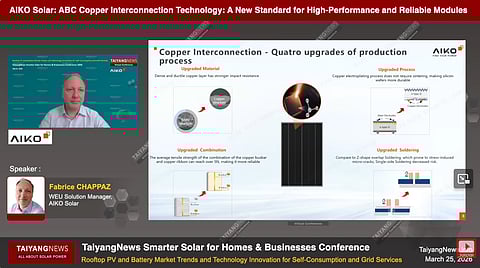


At the TaiyangNews Virtual Conference, Fabrice Chappaz of AIKO discussed the company’s BC module design and its copper-based interconnection approach
The design places all contacts on the rear side and replaces silver with copper, with the module reaching up to 670 W and 24.8% efficiency
The presentation included data on energy yield, shading behavior, and mechanical performance
Solar module development is moving beyond incremental cell improvements. The focus is shifting toward integrated architectures that address optical, electrical, and mechanical losses together. Back-contact (BC) designs are gaining attention in this context, especially as manufacturers look to improve real-world energy yield and long-term reliability.
At the TaiyangNews Virtual Conference on Smarter Solar For Homes & Business 2026, Fabrice Chappaz, WEU Solution Manager at AIKO Solar presented the company’s All Back Contact (ABC) technology as part of this shift. The design relocates all electrical contacts to the rear side of the cell. This eliminates front-side metallization and associated shading losses. At the same time, the approach replaces conventional silver-based metallization with copper for both fingers and interconnection ribbons.
This combination addresses both optical and mechanical limitations of conventional designs. Removing front-side contacts increases the active area. Rear-side copper interconnection reduces stress concentration points. This helps limit microcrack formation. According to the presented data, copper-based contacts maintain electrical continuity under stress conditions, indicating improved lifecycle behavior.
At the module level, the ABC platform is implemented in a 72-cell dual-glass configuration. The module reaches an efficiency of 24.8% and a rated power output of up to 670 W. The design integrates Invisible Ribbon (0BB) technology, where interconnections are placed entirely on the rear side. A zero-gap cell layout is also used. Together, these features increase the active area and contribute an additional 15-20 W power gain. AIKO’s back-contact (BC) module has reached 25% efficiency, as reflected in the April 2026 edition of the TaiyangNews Top Solar Modules report (see TOP SOLAR MODULES Listing – April 2026).
The module design incorporates overlapping cells with a zero-gap layout, minimizing inactive areas. The absence of front-side metallization further reduces optical and electrical losses, supporting more uniform current collection across the module. Chappaz also referred to material considerations, particularly the shift from silver to copper. He noted volatility in silver pricing and supply, with copper positioned as a more stable alternative. Its higher ductility also improves mechanical flexibility and limits crack propagation under stress.
Performance under real operating conditions was another focus area. The presentation included results across multiple scenarios, including dust, forest environments, and partial shading. In conventional front-contact modules, shading directly affects current pathways and increases mismatch losses. In comparison, the BC architecture maintains current transport on the rear side. This reduces sensitivity to front-side shading. Based on the data presented, the modules show show approximately 5% higher energy yield under standard conditions. Gains increase further under more challenging environments, particularly in localized shading scenarios.
He further noted that the design also influences string-level behavior. The module is divided into multiple electrically active sections. This allows current flow to continue even when part of the module is shaded or affected by defects. When combined with copper interconnection, the module maintains power output even in the presence of microcracks. The data also included reliability metrics. First-year degradation is reported below 1%, followed by an annual degradation rate of ≤0.35%. The temperature coefficient is given as -0.26%/°C. Additional features include anti-ignition certification from TÜV Rheinland and design elements to improve shading response and thermal stability.
The company also outlined a broader product portfolio based on this ABC platform. The presentation further highlighted residential module configurations ranging from 470 W to 545 W. The portfolio spans residential, commercial & industrial (C&I), and utility-scale applications, indicating scalability across different installation segments.
The presentation titled ABC Copper Interconnection Technology: A New Standard for High-Performance and Reliable Modules is available on the TaiyangNews YouTube channel here.
