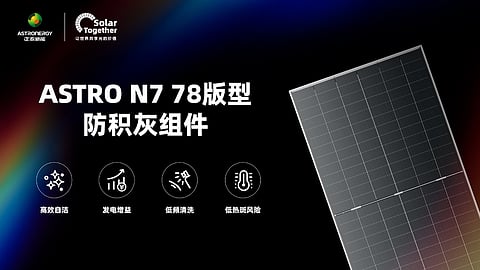

Astronergy’s latest ASTRO N7 78 series module features short-side frames at the same level as the front glass
This module, featuring half-cut cells with shorter busbar length, reduces power loss due to current flow and increases power output compared to standard G12 size-half-cell-based peers
The company has mass-produced these modules since early 2025
Astronergy, a well-known PV module maker and a CHINT Group subsidiary, recently unveiled its latest product featuring inherent resilience to dust accumulation, targeting China’s residential and commercial & industrial (C&I) rooftop installations.
According to the company, this module, which is part of its ASTRO N7 78 series, features 2 mm front and rear glass, both assembled with aluminum frames. In comparison to standard long-side frames that cover a small part of the front glass along the edges, the short-side frames design eliminates the cover. This design, thereby, places the short-side frames at the same level as the front glass. Unlike portrait-configured standard PV modules, installed at a certain inclination angle relative to the ground or roof level, this module design enables a certain percentage of dust to slide down across the short side (bottom) due to gravitational forces. In addition, the remaining dust particles are easily washed away by rainwater or dew deposition, typically at night, which prevents potential sedimentary deposition and inadvertent hotspot risks. Apart from reducing power losses due to dust accumulation, it also reduces module cleaning cycles. The company promotes this ‘anti-dust’ module for rooftop installations for residential and C&I use. Without providing details, the company says the module is also resilient to potential ultraviolet-induced degradation (UVID) under prolonged harsh sunlight.
In terms of performance metrics, this module features a tweaked layout by flipping each G12R (210 × 182 mm) half-cut cell by 90° (182 × 210 mm). Equipped with 156 half-cut cells, it delivers up to 750 W of power. The company claims that the module delivers a power gain compared to its G12 cell-based peers, attributing it to an optimized cell layout featuring a narrower busbar length (91 mm) printed along the short side of the cells (182 mm). Featuring dimensions of 2,465 × 1,303 × 33 mm, the company says this module size integrates ‘two classic size advantages’ of 2,384 × 1,303 mm and 2,465 × 1,134 mm modules and matches standard mounting brackets and is compatible with inverter systems.
These modules carry a product and performance warranty of up to 15 years and 30 years, respectively. The company states that these modules have been in mass production since early 2025.

