
Key takeaways:
Astronergy’s ASTRO N7s 3.0 targets the European residential market with up to 23.8% module efficiency and 475 W power
The series incorporates Astronergy’s latest TOPCon technology in a closely packed 20BB design
The modules are available in 96- and 108-half-cut formats, with bifacial dual-glass construction and optional all-black design
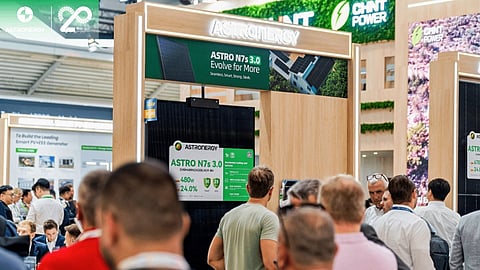
Chint Group subsidiary Astronergy unveiled its ASTRO N7s 3.0 residential module for the European market at Intersolar Europe 2026.
The module is based on the company’s latest TOPCon technology, which it calls TOPCon 5.0. This incorporates edge passivation, poly fingers, and fine line metallization technology to enhance passivation and the active illumination area. Measuring under 2 m² in area, the N7s 3.0 module offers a maximum power of 475 W with 23.8% conversion efficiency.
While not divulging the details, the company states that the module is built using larger cells (wafers); we surmise that it is based on the 182 × 210 mm wafer format. The cells feature a 20BB design and are packed closely in the module assembly, which – Astronergy claims – leads to a 1.1% increase in active area compared to products from its previous series. The module is constructed using dual glass, with an optional all-black version. The company says this module features ribbon optimization, which strengthens adhesion between busbars and ribbons. For the all-black appearance, the module features invisible pad points and a black light-redirecting film. The company states that the module is designed to integrate into any modern rooftop architecture.
Similar to other mainstream TOPCon modules, the Astro N7s 3.0 module features a maximum power degradation warranty of 1% in the first year and 0.4% starting from Year 2 until the end of its 30-year lifecycle, resulting in a power retention of about 87.40% at the end of this period. The modules in this series, with a maximum power output of 470-475 W, are built using 96 half-cut cells, measure 1,762 x 1,134 mm in dimensions, and weigh about 24.5 kg.
The larger version of AstroN7s 3.0 has similar technical specifications except for its module dimensions (1,961 × 1,134 mm) and weight (26.9 kg). This module is made of 108 half-cut cells. All modules under this series have a bifaciality of 80±5%.
The reliability testing results of these modules were also presented, with resistance against a 35 mm hail impact and mechanical load performance of +6,000 Pa / -4,000 Pa. Additionally, the modules are made using a flux-free interconnection process at a low temperature, reducing the carbon footprint and eliminating volatile organic compounds (VOCs), which result from flux usage in module assembly.

