
Key takeaways:
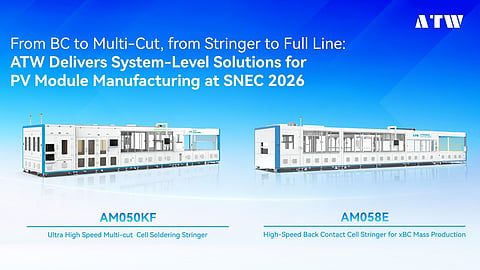
ATW showcased the AM058E BC stringer and AM050KF multi-cut cell stringer for emerging module architectures
The company complemented the equipment with complete BC and multi-cut manufacturing solutions covering multiple production steps
Beyond module assembly, the portfolio also included manufacturing solutions for solar cells and battery energy storage systems
Among the emerging trends in module assembly are the increasing adoption of back-contact (BC) cells and multi-cut cell designs. Both technologies pose new challenges during cell interconnection, where higher placement accuracy, lower mechanical stress, and faster processing speeds become important.
Wuxi Autowell Technology (ATW) showcased its manufacturing solutions at SNEC 2026 in Shanghai, with particular focus on 2 stringing platforms designed for BC cells (AM058E) and multi-cut cells (AM050KF).
Unlike mainstream cells, BC cells require ribbons to be precisely aligned on the rear and to minimize thermal and mechanical stress. According to ATW, its AM058E BC stringer can process over 6,800 half-cells per hour and accommodate cell sizes between 156 and 230 mm and thicknesses between 130 and 200 µm. The stringer has a ribbon placement accuracy of ±0.15 mm and string warp below 2.5 mm. ATW claims a rework rate of below 2% with this stringer.
The AM050KF stringer for multi-cut cell soldering is an ultra-high-speed stringer capable of processing 14,000 quarter-cut cells, 13,000 third-cut cells, and 11,000 half-cut cells per hour. The smaller the cell strips, the higher the number of interconnection operations and also the susceptibility to cracking. ATW claims crack rates below 0.2% with this stringer and a ribbon placement accuracy of ±0.2 mm. The tool supports 156-230 mm cell formats and also can process 5 to 24 busbars. For 0BB, the stringer has an integrated inline inspection and adjustment feature to apply glue in optimal quantity.
ATW emphasized that these stringers form a part of complete manufacturing solutions rather than standalone equipment. Alongside the BC stringer, the company presented a TOPCon-to-BC turnkey upgradation solution that enables manufacturers to convert existing TOPCon lines to BC with limited capital investment. It also highlighted its xBC interconnection package, which integrates glue dispensing, stringing, layup, and lamination. According to the company, supplying the complete process flow, rather than individual tools, helps reduce equipment integration challenges and simplifies the technology transition.
For a multi-cut module assembly line, ATW similarly offers a complete manufacturing solution that combines cell sorting, scribing, high-speed stringing, layup, and pre-lamination inspection by matching the process and equipment coordination.
The company also showcased a broader manufacturing portfolio covering crystal growth, wafering, cell production, module assembly, and battery energy storage manufacturing. The latter includes intelligent production lines for battery modules, packs, and containerized systems.

