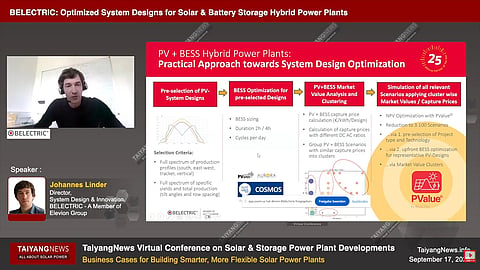

Johannes Linder, Director, System Design & Innovation at BELECTRIC, a member of the Elevion Group, shared ideas on optimizing system designs for PV-plus-storage hybrid power plants, particularly in Germany, at the TaiyangNews Solar Power Plants & Storage Conference 2026. His presentation focused on hybrid system design optimization for engineering, procurement, and construction (EPC) firms and investors.
Linder shared a German co-located PV + battery energy storage system (BESS) system design case study with a 1:1 PV + BESS AC-coupled configuration as a reference project. In 2024, BELECTRIC simulated the project and found that a 58 MW BESS size corresponds to the project's highest Net Present Value (NPV).
NPV, which indicates how much value a project is expected to add to a business in current monetary terms, is considered a key performance indicator (KPI) for optimization. Back then, the company could adjust BESS and PV size by optimizing the ratio of fixed-tilt and tracker-based systems within a given land area to get maximum BESS revenues. Linder argued that although these optimization types still apply to grey BESS, which charges itself from either PV or the grid, Germany has changed a few frameworks. These include regulations backed by grid oversizing, such as flexible grid connection agreements (FCAs), grid connection restrictions for grey BESSs, right balancing between the grid operator's acceptance and project profitability, and a focus on green BESS. Green BESS allows only renewable energy to charge it.
From an investor's perspective, the company follows optimized system design in three stages: 1) Set the project frameworks; 2) Define technology and design parameters; and 3) Check sensitivities/critical assumptions. However, Linder noted that these procedures make hourly battery simulation challenging, with many possibilities and scenarios.
The company has adopted a ‘practical’ four-step approach to address challenges. They are: pre-selection of PV system designs, BESS optimization for pre-selected designs, PV + BESS market value analysis and clustering, and simulation of all relevant scenarios. In a nutshell, this clustering of market value analysis reduces the need to handle too many simulations.

Linder shared a case study for a PV + green BESS hybrid plant system design with an AC-coupled system architecture, no grid restrictions, and within 33 ha of land in Central Germany, following these steps. The simulation results showed that the optimized BESS size is 40% of PV MWp with a corresponding backup duration of 4 hours. For PV + BESS optimization, a 45 MWp PV array mounted on a fixed mounting structure with a 3P module mounting architecture at a 10° inclination angle showed the highest NPV and ranked first. In comparison, modules mounted on trackers, those installed along the east-west (E-W) direction, and those mounted vertically relative to flat land ranked at 178, 782, and 3,005, respectively.
