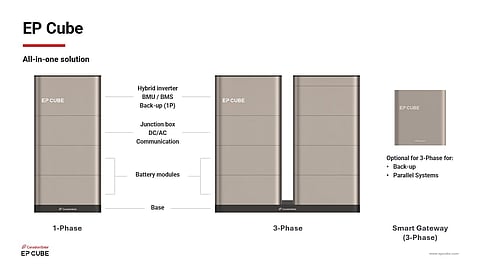

EP Cube’s 1-phase ESS combines a 7.6 kW hybrid inverter and vertically stacked 5 kWh battery modules on a single prefabricated base
The 3-phase ESS variant offers higher storage and rated power of up to 40 kWh and 12 kW, respectively
These products carry a warranty of up to 10 years
During the TaiyangNews Inverters and Battery Storage Conference 2025, Andrea Praticò, Director Sales of Energy Storage EP Cube, the energy storage arm of Canadian Solar, presented the EP Cube energy storage system (ESS). This ESS is targeted at residential and commercial & industrial (C&I) solar-plus-storage prosumers in Europe.
According to Praticò, this system features a vertical stack of a hybrid inverter (at the top), junction box (in the middle), and battery modules over a prefabricated base, available in either 1-phase or 3-phase variants. Each step is housed in metal enclosures with a uniform design, creating a sleek appearance for this ‘all-in-one' system.
In the 1-phase category, the inverter is designed to support a PV array of up to 12 kW through 2 built-in MPPT channels and is rated for up to 7.6 kW full-load current (AC). Equipped with 5 kWh battery modules, it offers an energy storage flexibility range of 5 kWh to 20 kWh, by vertically stacking up to 4 modules. It supports both AC-coupled and DC-coupled configurations.
3P EP Cube, the 3-phase variant, offers a higher storage range of 10 to 40 kWh to cater to connected loads of up to 12 kW (AC) via an inverter that features 4 MPPTs. The inverter, with a starting voltage of 80 V (DC), can support small strings with as few as 2 PV modules and help with complex rooftop projects. This storage capacity can be further scaled up to 200 kWh (5 × 40 kWh) with a corresponding power output of 60 kW by connecting 5 modular units in parallel. In addition, during grid failure or load shedding, 2 units (2 × 40 kWh) are connected via a gateway (hardware) and provide backup of up to 24 kW (AC) for up to 3.33 hours at a nominal discharge rate. The system stores excess solar energy and discharges the same during evening peak hours, typically during high tariff periods, via the HomeConnect energy management system.
Each battery module, with a plug-and-play design, weighs less than 42 kg and can be vertically installed over the base within 30 minutes. Its double-base structure also allows for quick expansion of storage capacity. Its sleek design helps achieve a power density of up to 63 kWh/m³, claims Praticò.
In terms of safety, each battery module with an in-built battery management system (BMS) logs events that capture comprehensive system behavior in real time. According to Praticò, it uses blended AI algorithms to analyze patterns, enabling fast and accurate root cause analysis, and shuts down the system after assessing potential safety risks. The company uses arogel between battery cell-to-cell gaps to restrict potential thermal runaway, while the battery module’s rated operational temperature range of -20°C to +50°C. These batteries carry a warranty of up to 10 years.

