
Key takeaways:
ConfirmWare showcased stringing solutions for BC cells and multi-cut module designs at SNEC 2026
The equipment targets challenges associated with rear-contact interconnection, higher solder joint counts and high-density module assembly
The broader portfolio also includes NDC, stringer layup, bussing, and turnkey module manufacturing solutions
As module technologies continue to evolve, module assembly, especially the cell interconnection process, is becoming increasingly demanding. The adoption of back-contact (BC) technology, the use of multi-cut cell design, and high-density packaging are 3 main trends in module assembly that make cell interconnection challenging.
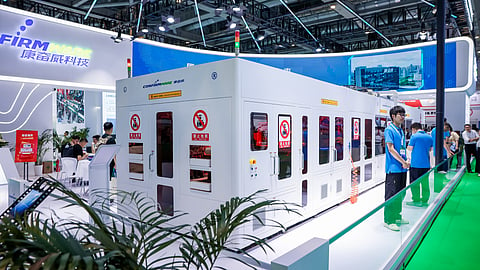
At SNEC 2026 in Shanghai, Chinese module assembly equipment supplier ConfirmWare showcased its latest stringers targeting these trends. The company highlighted a BC stringer and an ultra-high-speed multi-cut cell stringer as part of its turnkey module manufacturing solutions.
BC cells, with all contacts present on the rear side, pose a set of challenges involving ribbon alignment, soldering precision, and cell warpage. According to ConfirmWare, its BC stringer has been optimized to address these aspects through precision stringing and soldering designed to improve production yield for industrial-scale manufacturing.
The second product was the company’s multi-cut cell stringer. Module manufacturers increasingly adopt 3-cut and 4-cut cell configurations to enhance module power. However, this increases the number of solder joints and increases process complexity. ConfirmWare states that its latest multi-cut stringer supports throughputs of up to 14,000 cells per hour. It also combines high-precision motion control and AOI-based inspection methods.
Multi-cut configurations are typically complemented by high-density packaging, which involves cell overlapping. The overlapping induces mechanical stress and may result in cell cracking during handling. Earlier this year, ConfirmWare spoke to TaiyangNews as part of the Solar Module Production Equipment Market Survey, highlighting the developments in its stringing platform to support high-density module designs using overlapping cell layouts. In such architectures, a thin film is inserted into the overlapping region to reduce mechanical stress at the cell edges and lower the probability of crack formation.
Beyond these stringing platforms, ConfirmWare also presented its broader module assembly portfolio, including non-destructive cutting (NDC), stringer layup, bussing, and full turnkey manufacturing solutions.

