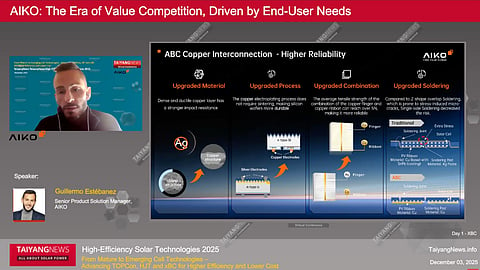


AIKO has developed a silver-free copper-plating metallization process for BC cells
Copper electroplating eliminates high-temperature sintering, reducing thermal stress on wafers and avoiding oxidation-related challenges
AIKO’s approach combines copper-based contacts, interconnections, and linear soldering to improve reliability and reduce mechanical stress
Metallization remains an important area of development for BC technology, particularly as manufacturers seek to reduce costs and dependence on silver. Recent developments in copper- and aluminum-based metallization are helping BC manufacturers reduce silver consumption while maintaining performance and reliability. While none of this is new, a recent development is the application of low-cost metallization in BC. AIKO, for example, developed silver-free copper plating-based metallization processes. Jolywood has developed a metallization technology that uses aluminum as the primary metallization ingredient.
While details of Jolywood’s aluminum-based metallization scheme are not known, AIKO’s Senior Product Solution Manager, Guillermo Estébanez, presented the details of its copper-based metallization at the TaiyangNews flagship event.
AIKO introduced 4 major upgrades as part of this silver-free metallization strategy. The first upgrade relates to materials. By replacing silver with copper at the contact level, the structure benefits from higher electro density and a robust gridline that doesn’t break even at 9° bending, according to Estébanez.
The second upgrade focuses on the process. Unlike conventional silver-based metallization, copper electroplating does not involve high-temperature sintering, thereby avoiding thermal stress on the silicon wafer. The copper process operates at lower temperatures, reduces stress, and avoids issues such as oxidation and corrosion, while also offering cost advantages.
The third upgrade concerns the material combination. The interconnection uses copper consistently across both fingers and ribbons, eliminating the need for mixed-material systems such as aluminum-based combinations. This uniformity improves mechanical stability and electrical performance.
The final upgrade addresses soldering. Conventional busbar-based designs often rely on Z-shaped soldering, which introduces localized stress and increases the risk of microcracks. In contrast, AIKO and other BC producers use linear soldering, reducing stress during the joining process by roughly 50%.
The text is an edited excerpt from TaiyangNews’ report on Cell & Module Technology Trends 2026, which can be downloaded for free here.
