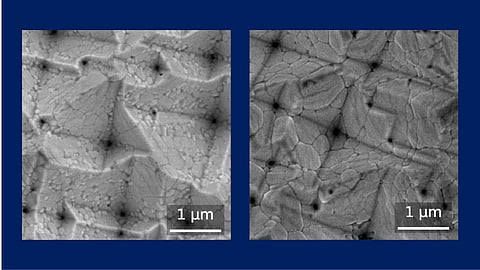


HZB researchers used a cesium chloride seed layer to improve co-evaporated perovskite growth on textured silicon
The seed layer reduced residual lead iodide at the interface and produced a more uniform perovskite film
The best tandem cell achieved 30.3% efficiency in-house, while an independently certified cell reached 29.7%
Perovskite-silicon tandem cells have achieved efficiencies above 34%, but growing a uniform perovskite layer on textured silicon remains difficult. Researchers at Helmholtz-Zentrum Berlin (HZB) used a thin cesium chloride (CsCl) seed layer to improve this growth. The layer reduced residual lead iodide at the interface and helped the team achieve 30.3% efficiency for a monolithic tandem solar cell.
Perovskite-silicon tandem cells combine a perovskite top cell with a silicon bottom cell to absorb a broader portion of the solar spectrum. The silicon surface contains microscopic pyramids that improve light trapping but also make it more difficult to deposit the layers above it uniformly. In this study, the researchers used vacuum co-evaporation, a solvent-free process that can coat textured surfaces, to deposit the perovskite absorber.
Before depositing the perovskite, the researchers applied a hole-transport material known as MeO-2PACz. This material is intended to form a thin self-assembled molecular layer over the microscopic pyramids on the silicon surface.
Using infrared microscopy at HZB’s BESSY II research facility, the researchers found that MeO-2PACz did not cover these pyramids uniformly. The material accumulated in the valleys, leaving thinner coverage on the pyramid surfaces.
X-ray photoemission electron microscopy showed that this variation affected the initial formation of the co-evaporated perovskite. In areas with thin MeO-2PACz coverage, the organic precursor was not incorporated effectively. This left residual lead iodide at the buried interface between the hole-transport layer and the absorber.
To address this problem, the researchers deposited a thin CsCl seed layer over the MeO-2PACz layer. The seed layer promoted more consistent precursor incorporation, including in areas where the underlying layer was thin. This suppressed residual lead iodide and enabled more uniform perovskite growth with larger apparent grains.
The improved interface mainly increased the tandem cells’ open-circuit voltage (Voc) and fill factor (FF). The best cell achieved 30.3% efficiency, with a Voc of 1.86 V and an FF of 80.3%, while an independently tested device reached a certified and stabilized efficiency of 29.7%, with a Voc of 1.86 V and an FF of 80.9%. Cells containing CsCl also showed less variation in efficiency and perovskite bandgap than those without the seed layer, indicating more consistent film growth.
The findings were published in Joule in a paper titled CsCl seed layer homogenizes co-evaporated perovskite growth for high-efficiency, fully textured perovskite-silicon tandem solar cells.
