
Key takeaways:
Mondragon Assembly offers 4 CTS variants built on a common platform, covering single-lane, dual-lane, ECA-based, and lab-scale interconnection needs
All models support multiple cell formats and interconnection approaches, including MBB layouts, BC compatibility, and both soldering and ECA processes, depending on configuration
Throughput and application scope vary across the portfolio, ranging from high-capacity production tools to low-throughput laboratory systems for process development
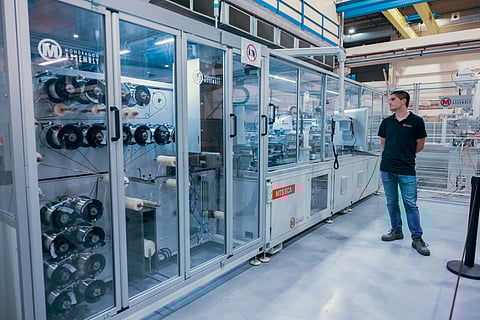
Mondragon Assembly from Spain, a leading module production equipment solution provider outside China, has provided data on 4 combined tabber-stringer products – MTS3000XL, MTS6000XL, MTS ECA, and MTS LABO, for TaiyangNews’ Market Survey on Solar Module Production Equipment 2026. MTS3000XL represents the company’s current core tool platform, introduced in 2022, and is also claimed to be the fastest single-track system. The MTS6000XL, a 2023 model, is built on the same platform but is offered in a dual-lane configuration to meet high-throughput demands. The MTS ECA, as the name suggests, uses ECA for interconnection, which was primarily developed for low-temperature soldering desired for HJT in its early development days. Mondragon also offers a lab tool called MTS LABO, a versatile machine that can perform interconnection via soldering as well as ECA.
All 4 models share a common design platform that supports MBB interconnection, BC processing, and compatibility with various wafer and cell formats. The equipment range uses single-lane processing – except the dual-track MTS6000XL – and uses a conveyor belt system to transport strings through the layup interface. Both tabbing and stringing occur simultaneously across the platform. The models are designed to cover different throughput levels, handling capabilities, and integration requirements within PV module production. The machines support both flat and round ribbons and are compatible with Sn60Pb40 alloy ribbon coating with a thickness of at least 20±5 µm. The equipment can be made compatible with lead-free ribbon upon customer request.
Cell loading is automatic. The number of cassettes varies by model: MTS3000XL and MTS ECA support 9 cassettes with 200 cells per cassette, while MTS6000XL simply doubles that to 18 cassettes. The loading configuration for MTS LABO – the lab tool – is naturally lower at 50 cells per cassette.
Across the models, post-stringing inspection is carried out using EL imaging and inline AOI before lamination. Cell inspection is performed using a vision system camera that detects cracks, chips, printing or metallization defects, and metallization positioning defects. Cell alignment also uses a vision system camera with a maximum deviation of 0.1 mm and a maximum angular deviation of 0.04°. Ribbon positioning accuracy is achieved using guided loading grippers and down-holders on both sides of the cells, with a maximum deviation of 0.2 mm on the front side and 0.3 mm on the rear side. Flux application varies by model. MTS3000XL and MTS6000XL use ribbon soaking for flux application, with optional cell fluxing available on request.
MTS LABO also supports ribbon soaking as a flux application when configured for soldering, but it is not applicable when using ECA, like with MTS ECA.
The soldering method for all models except MTS ECA uses infrared lamps and heating plates to achieve process temperatures between 120°C and 220°C. MTS ECA, on the other hand, uses heating plates with a 50°C to 180°C temperature window for ECA curing. All models use multiple solder points per tab with a standard distance of 12 mm between points, depending on the printed pattern on the cell.
As for the incoming raw materials, Mondragon’s equipment range supports cell sizes up to 230 mm, with thicknesses between 130 µm and 300 µm. They can process full cells, half-cut cells, and 1/3-cut cells, with adaptability to other formats upon request. All 4 models support multi-busbar designs up to 24BB, with a 10.8 mm busbar spacing for a 16BB design across all wafer sizes. The busbar changeover time is 8 hours for all models except MTS LABO, which requires 12 hours.
The systems accommodate both flat and round ribbons, with flat ribbons measuring 0.5 × 0.2 mm and round ribbons with a diameter of at least 0.25 mm. Ribbon coating of Sn60Pb40 alloy with a thickness of at least 20±5 µm is supported, with lead-free ribbon compatibility available upon request. Mechanical properties of the ribbon include elongation of at least 25%, a maximum yield strength of 90 MPa, and a minimum tensile strength of 270 MPa. Ribbon spools feature inner diameters of 15 to 20 mm, outer diameters of 160 to 200 mm, and a maximum spool weight of 12 kg.
The equipment range processes strings with a standard number of 9 to 12 cells per string, while MTS LABO supports a maximum of 10 cells per string. The maximum string length supported by all models is 2,500 mm. The systems support standard module cell spacing of 1.5 to 3 mm, and also support BIPV modules with cell spacing of up to 50 mm. Mondragon assures a peel strength of 100 gF/mm² across its production equipment range.
The cycle time for one production cycle is specified as 1.2 seconds for all models except MTS6000XL, which operates at half this rate, at 0.6 seconds, due to its dual-lane configuration. However, production capacities differ slightly even when singling out the dual-track system. As the numeric portion of the model name indicates, the maximum throughput for MTS6000XL is 6,000 cells/h, while the single-track variant of the same machine, MTS3000XL, reaches half of it, i.e., 3,000 cells/h. The ECA-based machine, MTS ECA, has a lower net maximum throughput of 2,400 cells/h. These production capacities translate into estimated annual capacities of about 200 MW, 100 MW, and 75 MW, following the same order as above. The lab tool, for which throughput is not a major performance metric, has a capacity of 100 cells per hour. The mechanical yield of all models is reported to be 98%, with less than 0.2% breakage, while the process yield exceeds 99.5%. The total system uptime for all equipment is 95% per year.

The text is an edited excerpt from TaiyangNews’ latest Market Survey on Solar Module Production Equipment 2026, which can be downloaded for free here.
