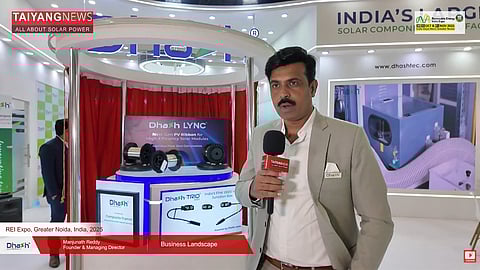

The latest DhaSh LYNC PV ribbons are being manufactured at DhaSh PV Technologies’ in-house factory with 6.5 GW annual production capacities
The company is targeting to scale up to 25 GW by March 2026
It also showcased the commercially available 2 kV PV JBs at the show
Manjunath Reddy, Founder & Managing Director of DhaSh PV Technologies Limited, an Indian manufacturer of PV junction boxes (JB), cables, and connectors, gave a brief overview of the latest showcases at the Renewable Energy India (REI) Expo 2025, during a one-on-one conversation with the TaiyangNews team.
Among the showcased products, Reddy emphasized DhaSh LYNC PV cell-to-cell interconnect ribbons launched at the event. The company’s website states that it features a uniform solder alloy coating over the core copper ribbon, ensuring healthy solder joints that carry electrical current via cell busbars (BB). It also states that the ribbon’s low conductivity, which it doesn't quantify, helps reduce power losses across cells. These ribbons are available in various widths and thicknesses. In terms of quality, these are tested to the prerequisite tensile strength and elongation for long-term mechanical integrity during field operations. In addition, its solder alloy coating prevents corrosion due to the oxidation of the copper core.
The DhaSh-TRIO PRO split JB, also on display, features a rated current of 35 A and a maximum DC system voltage of 2,000 V. According to the company, it supports TOPCon, HJT, and perovskite modules. Reddy claims this product is the first of its kind to be developed in India.
In terms of manufacturing and the way ahead, Reddy states that the company has up to 63 GW of PV JB and 6.5 GW of PV interconnect and bus ribbon annual production capacities. It aims to expand the latter component to up to 25 GW by March 2026. It is also adding capacity for electron beam cross-linked solar cable manufacturing of up to 1,000 km per day. The company currently has around 1,700 employees and plans to add up to 10,000 new jobs by 2031.
TaiyangNews is coming back to India with the 2nd edition of the Solar Technology Conference India (STC.I 2026) on February 5 and 6 next year. The event will bring together the who’s who and emerging players in the Indian solar PV manufacturing space. Details are available here.

