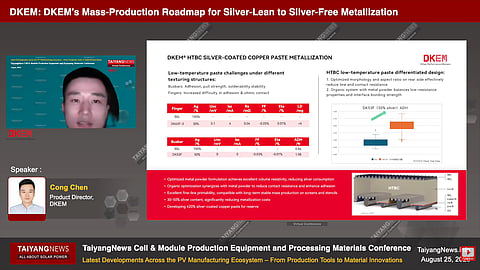

DKEM presents silver-lean and silver-free metallization solutions for several PV cell technologies
Its TOPCon process uses a low-silver seed layer and a copper-rich top layer
Pure copper paste is undergoing reliability and system-level testing before commercialization
Silver – a top material cost contributor in PV cell manufacturing – continues to be a topic of interest for cost reduction solutions. At the TaiyangNews Cell & Module Production Equipment and Processing Materials Conference, Cong Chen, Product Director at metallization paste manufacturer DKEM, presented the company’s silver-lean and silver-free metallization solutions.
Copper has become the best alternative to silver, with resistivity closer to silver and good solderability. Nickel is also used to some extent, although its resistivity is much higher than silver's.
The company offers a combination of solutions for technologies such as TOPCon, heterojunction (HJT), TOPCon-based back contact (TBC), and hybrid-passivated back contact (HTBC).
DKEM started reliability testing of silver-coated copper paste in 2023, with about 10% silver content. Chen said the current silver content for HJT cells is 25-35% for the front-side fingers and 10-20% for the rear-side fingers. To some extent, the reduction in silver content is also attributed to the use of stencil printing.
The company also expanded this solution to TOPCon, BC, and HTBC manufacturing. For HTBC, since one polarity is passivated with HJT, a low-temperature paste can be used. However, for the other polarity, which is TOPCon-passivated, the surface is polished, which can create adhesion challenges and lead to high contact resistance. DKEM optimized the metal powder and the paste to ensure effective interfacial adhesion on the polished surface. For HTBC, the company achieved a paste solution with 50% silver content and plans to further reduce it to 20%.

For TOPCon, the company offers a two-step metallization process in which it first prints a low-silver seed layer, and the top layer contains a high-copper-content layer (20% silver content). Chen said the process adds 2 minutes on a mass-production TOPCon line. He also said this solution currently supports a total mainstream TOPCon production capacity of 40 GW. This approach cuts silver consumption and finger laydown by 50%. Chen said the paste is also compatible with the edge passivation process of sliced finished cells, during which the paste’s poor thermal stability may create dewetting of silver-coated copper, leading to copper oxidation.
Finally, DKEM is also working on implementing pure copper paste, which comes with challenges such as copper oxidation, printability, copper diffusion, etc. The company developed a paste with so-called ‘hybrid preservation technology’ that prevents copper oxidation. This paste is compatible with multiple sintering methods and single- and dual-metallization approaches. For HJT and HTBC (HJT polarity region) cells, the copper paste can replace silver-coated copper and be cured at 200°C. For TOPCon and TBC, which use silver as a seed layer on the silicon surface and low-silver paste on top, the top layer can be replaced with pure copper paste. In this solution, the curing can also be carried out at 300°C. The copper paste has also undergone reliability testing according to 3× IEC, and several system-level tests are still underway. Other technical assessments remain for the copper paste; their results will determine the commercialization of pure-copper metallization paste, says DKEM.
Full presentation titled Low-Silver & Pure-Copper Metallization Routes, can be accessed here.
