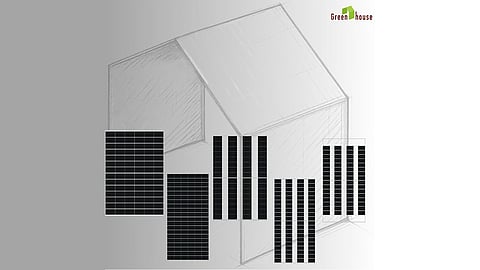


DMEGC Solar has upgraded its Greenhouse module range with G12RT cell technology
The modules offer 340 W to 580 W output, with efficiencies reaching up to 23.59%
They feature an n-type bifacial glass-glass design with a 15-year product and 30-year power warranty
Agrivoltaics is gaining momentum as solar moves into agricultural settings. These systems combine power generation with crop cultivation, especially in greenhouses and open fields. Managing light becomes important, since shading from modules can directly affect plant growth. This is creating demand for modules that can balance energy generation with controlled light transmission. This is driving a shift from conventional opaque modules to application-specific designs that integrate energy generation with controlled light transmission.
DMEGC Solar targets this sector with its Greenhouse series, part of its broader Agri-PV portfolio. The modules are designed for greenhouse, horticulture, and open-field applications, supporting dual land use by combining power generation with agricultural activity. The latest generation builds on earlier M10RT-based designs and transitions to G12RT cell technology. The company says this shift enables higher power output while maintaining the transparency required for crop cultivation. It adds that rather than a complete redesign, the update builds on the existing platform and remains compatible with current greenhouse systems.
The company offers multiple-module configurations, with power outputs ranging from 340 W to 580 W and efficiencies reaching up to about 23.59%. Higher power variants use larger-format G12RT cells.
According to the company, a defining feature of the series is its adjustable transparent area. The modules offer light transmission from about 2% to 50%. This allows system designers to tailor installations based on crop type, greenhouse structure, and local climate. Higher-transparency modules are suited for light-sensitive crops. While lower-transparency variants prioritize energy generation.
The product lineup also varies in cell layout, module dimensions, and electrical configurations. This supports flexibility across different Agri-PV applications, from crop-focused greenhouse systems to installations where higher power density is required. The modular approach allows adaptation without changes to the core technology platform, says DMEGC Solar.
In terms of construction, the modules use bifacial n-type cells in a glass-glass format. This design is suited for agricultural environments and offers durability against environmental stress. The modules are rated for mechanical loads of around 5,400 Pa for snow and 2,400 Pa for wind. They support system voltages up to 1.500 V. Electrical configurations are designed to manage partial shading typical of greenhouse structures.
The modules are designed for integration into both new and existing greenhouse systems. According to the company, the series supports dual-use installations while maintaining agricultural productivity by combining controlled light transmission with energy generation. Standard reliability features include a 15-year product warranty and a 30-year power warranty. The company claims a degradation of about 1% in the first year and around 0.4% annually thereafter.
At the TaiyangNews Reliable PV Module Design 2025 Conference, Alejandro Coll García of DMEGC Solar discussed how reliability is being built into advanced PV module designs (watch presentation here).
