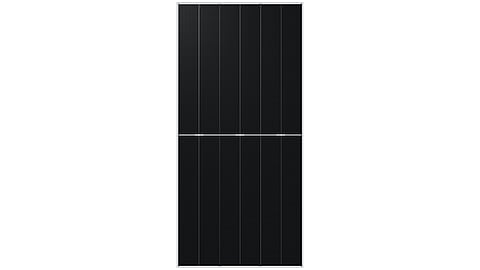


DMEGC Solar has introduced steel-frame PV modules with snow and wind load ratings of up to 6,000 Pa and 5,000 Pa, respectively
The new S-shaped frame design reduces rear-side shading by 76% and increases the unshaded rear area by 3.6%
The company reports bifaciality of up to 85% and a simulated 0.6% increase in annual power generation revenue compared with conventional modules
Solar module manufacturer DMEGC Solar has unveiled a new steel-frame design for its solar modules. According to the company, the new design improves mechanical reliability and can withstand snow loads of up to 6,000 Pa and wind loads of up to 5,000 Pa under specified mounting conditions.
It features a new S-shaped frame cross-section, which reduces shading caused by the frame on the rear side of the module. The company reports a 76% reduction in rear-side frame shading, increasing the unshaded area by 3.6%. This is expected to improve bifaciality by approximately 2.8%. Combined with newer cell technologies and an anti-reflective coating on the rear glass, the company states that its modules can achieve bifaciality of up to 85%.
According to its simulations, the modules could generate 2,078 kWh/kWp annually, resulting in about 0.6% higher power-generation revenue than conventional modules. However, actual gains would depend on installation conditions, including ground reflectivity and module mounting height, the company adds.
DMEGC Solar states that the steel used has nearly twice the tensile strength of conventional aluminum alloys. Steel also has a lower coefficient of thermal expansion of 12 × 10⁻⁶/K, compared with 23 × 10⁻⁶/K for aluminum and 6.9 × 10⁻⁶/K for glass. As steel’s value is closer to that of glass, the company expects less thermal stress during temperature changes, which could help reduce the risk of microcracks.
The company uses steel coated with zinc, aluminum, and magnesium (ZAM) to address corrosion concerns. The coating helps to protect the frame against environmental exposure, particularly in demanding installation conditions. DMEGC Solar also reports that the modules have passed independent salt-mist and ammonia resistance tests.
DMEGC Solar had previously discussed the steel-frame option at the TaiyangNews Reliable PV Module Design Conference 2026 in October. During his presentation, René Schüler, Head of Product Marketing Europe at DMEGC Solar, explained that the company was evaluating steel frames mainly for its Infinity RT 3.0 utility-scale modules (see DMEGC’s G12R TOPCon Module Design For Varied Applications).
The steel-frame option is primarily designed for DMEGC Solar’s Infinity RT 3.0 utility-scale module family. The G12RT-B66HSW series offers power outputs ranging from 640 W to 665 W, with module efficiencies of 23.7% to 24.6%. The dual glass bifacial modules use 132 half cells and measure 2,382 × 1,134 × 30 mm.