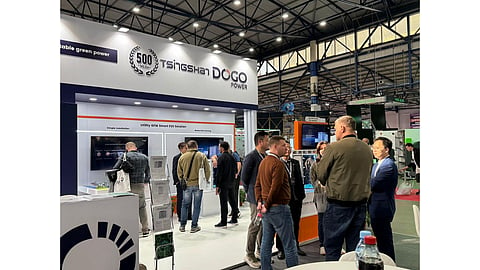


DoGo Power showcased its smart grid-forming energy storage solutions for C&I applications at EcoEnergy Expo 2026
Its 1.672 MWh containerized ESS integrates multiple system components into a 10-foot unit
DoGo Power signed cooperation agreements with three Ukrainian partners, including plans to deploy over 200 ESS units at agricultural research facilities
Energy storage provider DoGo Power presented its smart grid-forming energy storage solutions (ESS) at EcoEnergy Expo 2026 in Kyiv, Ukraine. The company is focusing on the country's commercial and industrial (C&I) market, where demand for reliable electricity and distributed energy storage is growing. According to DoGo Power, Ukraine aims to install 1.5 GW to 2 GW of energy storage capacity by 2030.
DoGo Power's ESS is based on its 4S platform, which integrates an energy management system (EMS), power management system (PMS), power conversion system (PCS), and battery management system (BMS). The company says the system can switch between grid-connected and off-grid operation within 20 ms and operate in weak-grid conditions with a short-circuit ratio (SCR) as low as 1. Its Eco series AI tools help optimize energy dispatch and operating parameters.
For C&I applications, DoGo Power highlighted its 1.672 MWh ESS housed in a 10-foot container. The company says the unit combines the functions of six ESS cabinets rated above 260 kWh each, a combiner cabinet, a grid-connected/off-grid switching cabinet, and an isolation transformer. Compared with a conventional configuration, the integrated design reportedly reduces initial capital expenditure by $0.012/Wh and installation footprint by 35%. The company also says it shortens project timelines by 5 to 7 days.
During the exhibition, DoGo Power announced cooperation agreements with three Ukrainian partners. Under its agreement with the Institute of Horticulture of the National Academy of Agrarian Sciences of Ukraine (IH NAAS), the company plans to deploy more than 200 smart grid-forming ESS units over the coming years. These systems will be installed in phases at research facilities and experimental farms. They will help maintain electricity supply during grid outages and prevent disruptions to agricultural research activities.
