
Key takeaways:
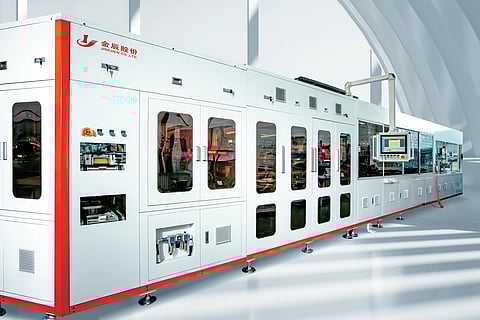
JC-CHYA10000 from Jinchen is a dual-lane CTS tool with integrated cell slicing and continuous IR soldering, designed for mainstream mono-silicon cell formats
The system supports half-cut and 1/3-cut cells, multiple busbar layouts up to 24BB, and overlapping layouts through adjustable negative cell spacing
The tool combines AI-assisted inspection with high throughput, reporting up to 10,000 cells per hour and system uptime of at least 95%
The TaiyangNews Market Survey on Solar Module Production Equipment 2026 features one CTS model from Jinchen, the module production equipment segment leader in China. Commercially introduced in 2025, the company’s JC-CHYA10000 operates in a dual-lane configuration and uses continuous IR heating for soldering. The tool includes standard manual cell loading, which can be upgraded to fully automated loading. It consists of 12 cassettes, each capable of holding up to 300 cells, whether full cells or half. The tool is also integrated with cell slicing. It is important to note that while JC-CHYA10000 does not currently support back contact (BC) cells, Jinchen claims to offer turnkey module production solutions that can support all cell and module types, including BC.
Cell transport is handled through a combination of robotic-arm transfer and conveyor-belt movement, and tabbing and stringing are carried out sequentially rather than simultaneously. Cells are inspected using an industrial infrared camera combined with AI-based defect detection. The system can identify micro-cracks, broken cells, edge chipping, and virtual soldering. Cell alignment relies on CCD inspection, and post-stringing inspection options include EL and AOI.
The tool has a footprint of 11,000 × 3,500 × 2,650 mm. Jinchen has provided the weights for different sections of the machine: 2,070 kg for the slicing area, 2,170 kg for the ribbon feeding, 6,100 kg for the soldering, and 3,200 kg for the output area.
Regarding incoming materials, JC-CHYA10000 supports monocrystalline silicon cells ranging from 166 mm to 230 mm, including half-cut and 1/3-cut cells, with minimum thicknesses of 110±10 µm. The system accommodates various busbar layouts from 3BB to 24BB, and the company specifies 16BB for M10 and 18BB for G12 – the 2 mainstream wafer sizes. The busbar spacing is given as at least 8.5 mm, and a minimum distance of more than 5 mm from the cell edge to the busbar. Standard layouts include 12 or 13 half-cell strings, with a maximum string length reaching 1,250 mm. Cell spacing is adjustable from -1 mm to 5 mm, and negative spacing indicates the capability to overlap module technologies. The tool supports round wire ribbons with diameters ranging from 0.25 mm to 0.45 mm. Ribbon specifications include elongation ≥25%, yield strength of 70-80 MPa, and tensile strength ≥150 MPa. Ribbon coatings consist of a tin layer with an average thickness of ≥0.018±0.005 mm. Both lead-containing and lead-free solder alloys are supported. Ribbon spools feature a core inner diameter of 16 mm or 20 mm, an outer diameter up to 180 mm, widths up to 160 mm, and a maximum weight of 12 kg per spool. Flux application is performed using a dipping tank. Ribbon positioning accuracy is specified as ±0.3 mm.
The tool has a production cycle time of 0.7 s, with an average and maximum throughput of 9,500-10,000 cells/h and over 10,000 cells/h, respectively. The annual production capacity exceeds 350 MW for G12 cells, assuming at least 330 operating days per year with 22.5 operating hours per day.
The mechanical yield is reported as 99.8% (≥99.7%), with a total system uptime of at least 95%. Assured peel strength varies by busbar configuration. For 9BB to 12BB using 0.29 to 0.4 mm ribbon, the peel strength spec is ≥0.8 N front and ≥1 N rear. As a note, the peel strength values correspond to the overall ribbon adhesion strength at the soldering points all along the length of the busbar, i.e., the soldering is not continuous. Jinchen assures that no more than 1 soldering point would have a peel strength of <0.5 N. For 13BB to 24BB using relatively thinner ribbons of 0.25 to 0.35 mm, peel strength is given as ≥0.4 N front and ≥0.5 N rear, with a maximum of one soldering point below 0.3 N per front-side busbar. Process yield of the tool changes according to the busbar count; string defect rates of ≤1.5% and rework rates of ≤10% for 9 to 12 BB cells, or ≤2% defect and ≤10% rework for 13 to 24BB cells. Busbar changeover takes up to 6 hours with a skilled technician.

The text is an edited excerpt from TaiyangNews’ latest Market Survey on Solar Module Production Equipment 2026, which can be downloaded for free here.
