
Key takeaways:
Ecoprogetti showcased a 2.5 GW turnkey module manufacturing line compatible with multiple cell technologies and module formats at Intersolar
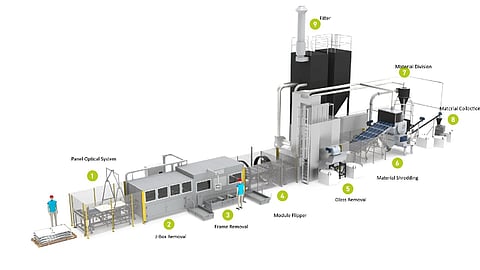
The company also presented automated recycling lines for dual-glass PV modules with capacities of up to 3 tons/h
Mechanical separation processes enable high-purity recovery of glass, silicon, copper, and aluminum from end-of-life modules
Turnkey manufacturing solutions from companies around the world have played a key role in the commercialization of advanced PV module technologies.
One such solution provider, Italy-based Ecoprogetti, presented its latest turnkey line for module production at Intersolar Europe 2026. The company also showcased an automatic equipment solution for recycling end-of-life dual-glass modules.
The turnkey solution for module production is a 2.5 GW automated assembly line, which requires about 14 personnel per shift. The throughput of each line is 400 modules per hour, which is most likely the maximum yield. The line, according to the company, is compatible with various cell structures, such as TOPCon, HJT, and PERC, and accommodates wafer sizes from M6 to G12 in full-cell, half-cut, and triple-cut configurations. The line's throughput varies with the module's final layout. The standard module size offered with this line is 2,500 × 1,400 mm, with custom sizes available as per the requirement.
For end-of-life panel recycling, Ecoprogetti offers two lines with different processing capacities: the first can recycle 1.5 tons/h, equivalent to 60 panels/h, and the second 3 tons/h, equivalent to 120 panels/h.
Both lines follow the same steps, starting with optical inspection to identify the module dimensions and junction box positions. This is followed by the removal of the frame and junction box, which is succeeded by the removal of the glass. After the glass is removed, the remaining laminate and other components are shredded into powder. The powder is then separated via gravimetric screening, which separates materials of different densities. For the recovery of silicon, an electrostatic separator is used and connected to the cyclone collection system via a suction system. The fine particles released into the air are collected and removed by filters in the air treatment system, which is integrated with the suction system.
According to Ecoprogetti, the purity of materials achieved using this method is about 98% for both silicon and copper, 99% for glass, and 100% for aluminum. The company did not specify the exact process of extracting silver from this recycling path.

