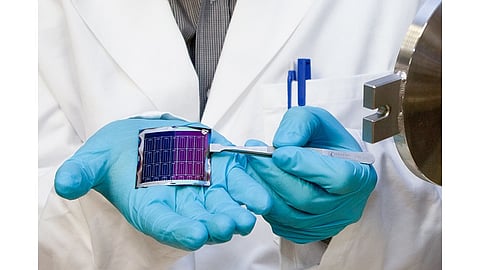


Empa researchers argue that work on CIGS and perovskite solar cells is currently too focused on record efficiencies and not on industry-ready products
The industry needs durable, reliable, and affordable products for large-scale deployment
Despite years of development and major investments, both CIGS and perovskites remain far from commercial success compared to silicon
The Empa study calls for earlier and closer collaboration between research and industry, with more attention on stability, resilience, sustainability, and real-world testing
It recommends learning from past thin-film PV experiences to avoid repeating mistakes, and encourages greater transparency from the industry
Research on promising solar cell technologies, namely copper indium gallium diselenide (CIGS) and perovskites, is largely oriented toward achieving record efficiencies, and not on what the industry needs for mass deployment. To ensure the industry has a reliable and cost-effective product to work with, researchers at the Swiss Federal Laboratories for Materials Science and Technology (Empa) stress that research and industry collaboration must start ‘much earlier’.
“It is much more important to the industry that the product has a long service life, is reliable, and can be manufactured cost-effectively than a few percentage points more efficiency,” explains Empa researcher Mirjana Dimitrievska, lead author of a study published in Nature Energy Journal. “In research, however, it is efficiency records that are rewarded above all else; they lead to high-profile publications and attract research funding.”
Despite reporting and breaking several records for high efficiency and increased private investment that should have led to their mass deployment, both these solar technologies are still far off the mark compared to their silicon counterpart.
CIGS, for instance, was once considered an alternative to silicon solar cells. Its development peaked in the 1990s and 2000s but lost out to the former as soon as silicon prices recovered. Relatively costly and complex manufacturing process for CIGS limited its growth, according to Empa research.
The same story continues with perovskites, which have been in development for around 20 years. By 2025, Empa estimates more than $500 million has been spent on perovskite solar cell development globally, yet its use is still limited, though the Chinese are advancing its development to GW-scale (see World’s ‘1st’ GW-Scale Perovskite Solar Module Fab Online In China). Perovskites are heavily sensitive to environmental influences and haven’t been tested widely under real-life conditions, highlight the researchers.
“Silicon is not the best semiconductor for solar cells,” Dimitrievska points out. “However, this technology has been in development for over 70 years and has already been greatly optimized thanks to continuous research and investment. If research and industry work together, the same can be achieved for perovskite and CIGS.”
Both CIGS and perovskites can enable the development of lightweight, flexible, extremely thin solar cells suitable for a variety of applications. Combining silicon with these in a tandem configuration is believed to boost cell efficiency even further.
To prevent the limitations of these emerging technologies from becoming ‘fatal’, the Empa team recommends that the research community train its lens on the material’s resilience, stability, and sustainability, as well as long-term field studies instead of focusing on efficiency records. The research community must factor in industry needs as early as possible, it recommends.
On its part, the industry must also be a little more open. “Sometimes, we approach an industry partner with an idea, and they tell us, ‘We tried that ten years ago, it doesn't work.’ If they published such negative results, research would progress much faster,” adds Dimitrievska.
“By bridging this historical perspective with the current frontier, we propose that the future of perovskites depends not only on continued innovation, but also on learning from past thin-film PV experiences to avoid repeating their pitfalls,” states the Empa team.
The Empa research, titled Lessons from copper indium gallium sulfo-selenide solar cells for progressing perovskite photovoltaics, was published in Nature Energy.
