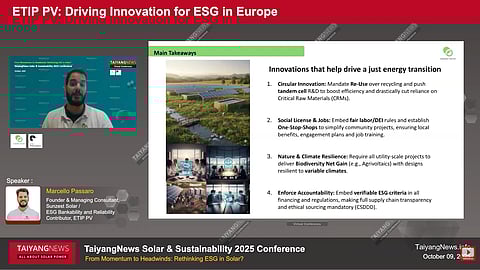

Key takeaways:
ESG in Europe is increasingly shaped by circular design principles, reduced material dependence, and early-stage decisions rather than end-of-life recycling alone
Social criteria, community engagement, and standardized worker protections are becoming more integral to project development and regulatory compliance
Upcoming EU rules and broader traceability requirements will require consistent, verifiable ESG processes rather than isolated or one-time compliance efforts
In the context of sustainability, Europe is evolving from a compliance obligation to a driver of innovation. This was the theme of Marcello Passaro's presentation from Sunzest at the TaiyangNews Solar & Sustainability virtual conference. Sunzest is an independent consultancy that focuses on mitigating technical and ESG risks for the PV and BESS stakeholders. Marcello’s perspective was presented from hands-on experience across module lines in China and Europe as well as field audits of operational PV systems.
One of the key points he emphasized was circularity, not in the common “recycle at the end of life” narrative, but in design-level decisions that reduce material dependence in the first place. He pointed to Europe’s growing focus on critical raw materials and argued that efficiency improvements, especially through tandem technologies, will be essential to reduce material intensity per watt. For him, circularity begins with reuse, better system design, and reducing the presence of problematic materials like PFAS in backsheets—an issue increasingly visible in European regulatory discussions.
Marcello also stressed that Europe’s ESG shift is not limited to environmental criteria. Social factors are becoming embedded in regulation and project development, from fair labor and diversity requirements to ensuring that workers across EU countries can easily transfer skills and qualifications. He highlighted a gap between solar and wind in terms of community engagement. While wind projects almost always include community engagements, he noted that solar projects rarely include them. A genuine community engagement and local participation will become essential ESG elements, especially with new European directives pushing for renewable energy communities.
On the regulatory side, Europe is moving towards mandatory ESG transparency across the entire value chain. Whether through the Corporate Sustainability Reporting Directive (CSRD), the incoming Corporate Sustainability Due Diligence Directive (CSDDD), the EU taxonomy, or digital product passports under ecodesign requirements, companies will soon need standardized and externally verified ESG data. He repeatedly mentioned SSI as an emerging reference point for the PV industry, especially with traceability becoming legally relevant from 2027. The parallel rise of schemes like EcoVadis and their increasing use of automated checks for the past few years of negative news checks means that companies will need consistent processes rather than one-off compliance exercises.
Marcello closed with observations from his own PV system audits, where he highlighted recurring issues such as lack of PPE on sites, limited biodiversity monitoring, missing community engagement plans, and insufficient checks on subcontractor working conditions, particularly with migrant workers. He argued that meeting regulatory minimums is no longer sufficient, and that good ESG practice requires third-party verification, clear data, and evidence-backed claims instead of generic sustainability statements.
This presentation can be accessed here on: Driving Innovation for ESG in Europe: Marcello Passaro, Sunzest.

