
Key takeaways:
JinkoSolar outlined its adoption of global ESG standards and its multi-ISO certification progress as part of its sustainability framework
The company presented increasing engagement in international traceability initiatives, including SSI and broader labor-standard compliance
A case study from Global Solar Council highlighted financial and structural reforms needed to expand solar deployment
At the TaiyangNews Solar & Sustainability conference, JinkoSolar’s Head of Sustainability Development, Lin Sun, presented insights into how the company structures its global ESG activities and how these measures directly support bankability in project development.
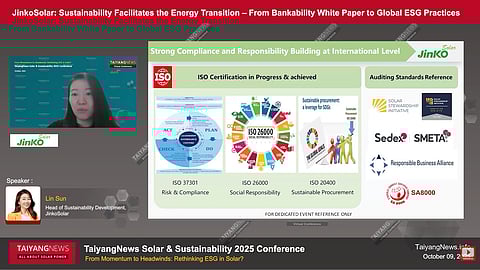
Lin Sun began by highlighting the company’s participation in major international ESG certification programs, including those from S&P, EcoVadis, and MSCI. However, she emphasized that more meaningful work occurs within its internal systems and with its partners. These efforts include embedding global standards like the UN Global Compact, UN Women’s programs, and ISO-based management structures, into the procurement and day-to-day operations. Lin Sun presented Jinko’s ongoing parallel work with 3 ISO standards: ISO 37301 for risk and compliance, ISO 26000 for social responsibility, and ISO 20400 for sustainable procurement. As of now, the last one, ISO 20400, has already been attained by Jinko, and the other two are expected to be accomplished by the end of 2025, as estimated by Lin Sun.
Jinko is also actively participating in global traceability initiatives. Lin Sun shared that the company is a longstanding supporter of the Solar Stewardship Initiative (SSI), and that several of its factories recently completed SSI-aligned audits. Currently, 2 Jinko factories have been certified with silver and bronze ratings for the ESG standard by SSI. It also refers to the Responsible Business Alliance (RBA), SMETA audits powered by Sedex, and the SA8000 audit, to meet several regional expectations around labor and supply chain practices.
Lin Sun presented a case study on the Global Solar Council’s (GSC) bankability position paper, named, How to Finance Solar for All, released during London Climate Week. Jinko chaired the Finance task force of the GSC, working together with Trinasolar and other stakeholders. The study explores methods to unlock the full potential of solar power through structural financial reform. Mapping the solar finance ecosystem, identifying core challenges across regions and value chains, and actionable solutions to risk, capital alignment, and sustainability integration are the key elements of this paper.
The paper proposes several actions to address these issues, among them are:
a stronger public-private partnership to revitalize capital for solar projects globally, create transparent information channels, and strategize risk mitigation
adopt fairer investment standards that account for high capital costs and low rates of returns in developing countries and emerging markets
enhance solar investment platforms by establishing collaborations between banks, financing associations, regional solar associations, and manufacturers
Lin Sun highlighted that the SSI was referred to as a successful case study under the multi-stakeholder collaboration. The full presentation of JinkoSolar can be accessed here: Sustainability Facilitates the Energy Transition.

