
Key takeaways:
LEAPTING’s white paper evaluates whether its robotic mounting system can match or exceed manual installation rates while maintaining placement accuracy and module integrity
The system is reported to install an average of 600 modules per day, with a battery runtime of up to 10 hours
Field validation data indicate higher installation throughput and reduced labor hours per MW compared to conventional manual operation
Module installation, whether at the residential, commercial, or utility scale, typically involves manual labor. Companies are exploring solutions to reduce labor costs and installation time.
LEAPTING is a China-based company that specializes in robotic solutions for the solar industry, such as cleaning and inspection of modules after installation. Module mounting is another area in which the company is invested. LEAPTING, in collaboration with Solarabic, a digital clean energy platform focused on the MENA region, recently released a white paper on an automatic module mounting robot. The white paper focuses on the robot’s installation accuracy, construction efficiency, operational safety, and quality consistency.
The white paper first identifies the pain points associated with the introduction of an automated installation technique. These include reliability to match manual crews’ installation rates of 200-300 modules per day, cost & ROI, workflow disruption, quality & safety, and module integrity. The robot is intended for ground-mounted utility and C&I projects, where automation could reduce manual labor, improve safety, precision, and productivity.
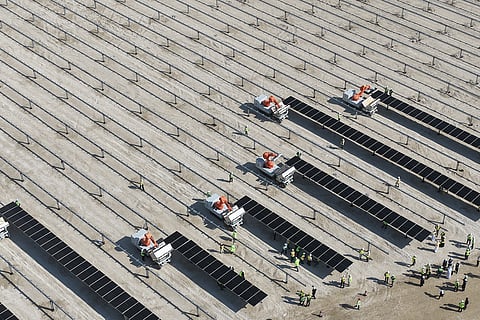
The module mounting robot has an arm reach of up to 3.1 m and a load-bearing capacity of 210 kg. It is equipped with a 400 Ah, 48 V LiFePO4 battery that requires 4-5 hours to charge and can run for up to 10 hours. Addressing the pain points mentioned above, the robot is capable of installing an average of 600 modules per day, taking about 25 minutes per pallet (36 modules), including loading time. For safety and precision, it is equipped with obstacle-avoidance radar and LiDAR sensors, enabling full path planning and stable movement in large-scale PV installations. According to the paper, the robot is quick to set up and commission on-site. It can be operated with minimal maintenance, featuring built-in capabilities for routine checks and fault handling. The robot requires one operator and 2 fasteners (to clamp the module).
A field performance validation was conducted comparing LEAPTING’s robotic mounting system with manual installation. The white paper reports higher installation throughput than manual teams and estimates that one robotic unit could substitute about 10 manual workers under certain project conditions, with potential overall cost reductions of around 30%. The robot is also capable of operating at temperatures between -20°C to +65°C, allowing deployment across a range of climatic conditions.
The white paper also features 2 utility-scale deployment case studies from Saudi Arabia and Australia. In the Australian project, the robot installed 7,140 modules in about 22 working days, averaging over 400 modules per day. There was a reported 33% reduction in labor hours per MW and zero safety incidents. The installation quality was checked by TÜV SÜD for surface scratches, microcracks, and placement integrity.
Future upgrades for the robot include automated fastening, a supportive forklift system, enhanced navigation algorithms, and improved battery performance.

