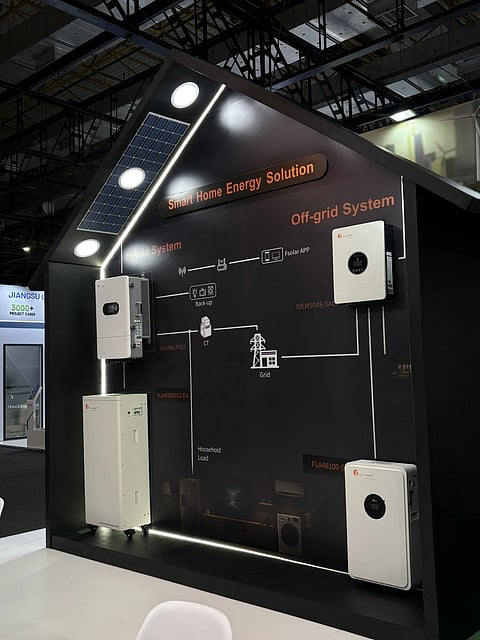

Felicitysolar showcased its IVGM8KLP2G1 series hybrid inverter and a FLA48280TG2-EU battery for residential applications at the show
The off-grid solution comprises a ‘Solar Inverter’ and a 48 V battery
It has two battery charging mode – solar + grid and solar only charging
China-based residential PV inverter and energy storage system (ESS) provider Felicitysolar showcased a wide range of products targeting the South American distributed generation market at Intersolar South America 2026.
The company's highlights included a hybrid ESS and an off-grid storage system.
The former system comprises an IVGM8KLP2G1 series hybrid inverter and a FLA48280TG2-EU battery. The inverter, featuring two MPPT channels, supports up to 12 kW of PV power. It is rated for a full-load power output (single-phase) of 8.8 kW and a current of 33.3 A. When paired with a 14.3 kWh battery, this system can serve as an 8.8 kW/14.3 kWh PV-plus-storage system. It supports a variety of domestic single-phase configurations, including 120/240 V (split-phase), 280 V (2/3 phase), and 220/230 V (single phase). According to the datasheet, the inverter’s enclosure is IP65-rated for ingress protection of IP65 and carries a warranty of up to 10 years.
The off-grid product, which the company calls a 'Solar Inverter', comes with a 48 V battery module. The inverter, IVEM 5048, has two battery charging modes – utility charging and solar + grid charging. In the first charging route, the storage gets 230 V power from the grid or a diesel generator. During the daytime, the battery can charge at a maximum rate of 100 A using solar energy only via a built-in MPPT charge controller, or a mix of solar and grid power. It is designed to bypass 5 kW of grid power (230 V single-phase) from the built-in inverter to feed household captive loads. This is called 'Line Mode'. In on-grid configuration, its inverter mode gets activated and provides up to 5 kW full-load power (230 V).

