
Key takeaways:
Ford Energy has launched battery energy storage systems based on 5.45 MWh containerized LFP battery platforms
The systems use 512 Ah prismatic LFP cells with integrated thermal management and multi-level battery management
Ford plans to support the business through a dedicated 20 GWh battery manufacturing facility in Kentucky
The growing importance of energy storage is drawing increasing interest from automakers, especially EV manufacturers, as they look to expand their horizons. While BYD and Tesla have been well-known names in this regard, Ford has followed suit with the recent launch of its energy business, Ford Energy. With an announced investment of $2 billion, the company aims to provide battery energy storage systems (BESS) for utility-scale, commercial & industrial (C&I), and data center applications.
According to its newly launched website, the company is developing a gigafactory in Kentucky with a projected annual capacity of 20 GWh, producing full battery cells, including electrode coils, and assembly of modules and containers.
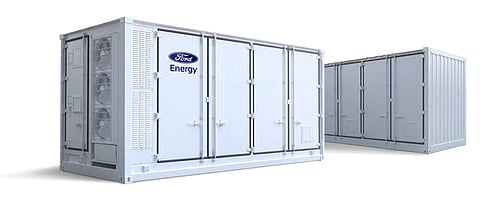
The company has followed this up by announcing its new product, the Ford Energy DC Block, a container with a capacity of 5.45 MWh. Available in 2 variants, the first, named FE-250, is a 2-hour system that enables the discharge of full rated energy in 2 hours. The second, FE-450, is a 4-hour system that discharges in twice the time of the former. The company uses 512 Ah lithium iron phosphate (LFP) prismatic cells, measuring 73 × 275 × 210 mm.
Both FE-250 and FE-450 use a 3-level battery management system to monitor electrical parameters, state of charge, and health to ensure stable operation. They also feature integrated liquid cooling and heating systems for optimal cell operation. Their thermal management system enables these systems to operate in the -35-55°C temperature range. They are also equipped with a fire suppression system that detects smoke, heat, and hydrogen, which can be ventilated and suppressed. The systems are packaged in standard 20-foot containers and weigh approximately 43.5 tons.
The products are expected to be commercially available from late 2027.

