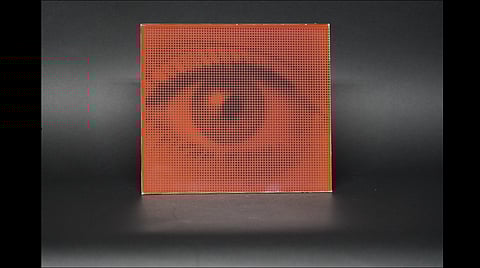


Fraunhofer ISE developed ‘ShadeCut’ films with transparent cutouts to create realistic patterns on PV modules
MorphoColor enables color generation with ~95% power output compared to standard modules
The technology supports applications in building-integrated PV, including façades and historic structures
The role of aesthetics in photovoltaics is increasing. This is particularly evident in building-integrated PV (BIPV) applications. Modules used on façades and rooftops must align with architectural requirements, especially in heritage settings. This is driving solutions that improve visual integration with minimal impact on efficiency.
At Fraunhofer Institute for Solar Energy Systems ISE, researchers have developed a solution based on colored films with structured cutouts that enable customized visual designs on solar modules. The concept, referred to as ‘ShadeCut’, uses MorphoColor technology to generate color impressions while maintaining high efficiency. The approach allows modules to mimic materials such as roof tiles or masonry, making them suitable for architecturally sensitive applications.
The ShadeCut design is based on the application of patterned cutouts to a color-producing film. These patterns are created using laser or CAD-controlled processes, enabling precise customization. The films can be integrated into standard PV or solar thermal modules, either as encapsulation layers or as backsheets. Additional layers with different cutouts can also be stacked to create more complex visual effects or multi-color structures.
“Through targeted structuring and cutouts on a color-producing film, we can integrate color effects and complex patterns directly into solar modules and facade elements,” said Marco Ernst, researcher at Fraunhofer ISE.
The technology also supports customization, such as logos or lettering, expanding its use beyond traditional installations. This is particularly relevant for applications such as railings, façades, and roof-integrated PV systems, where visual blending is required.
According to Fraunhofer ISE, the MorphoColor concept is inspired by the structural coloration observed in Morpho butterfly wings. Instead of pigments, color is generated through micro- and nano-scale surface structures that create interference effects. The institute claims to have replicated this principle by applying similar photonic structures to the rear side of the module cover glass using a vacuum process. It adds that, depending on the microstructure design, different colors can be achieved with an angle-stable appearance .
Fraunhofer ISE says it has recently extended the concept from glass coatings to films. This enables integration into encapsulation layers or backsheets, improving compatibility with standard module designs. The institute reports that modules with MorphoColor retain around 95% of the power output of uncoated modules, indicating limited optical losses.
The technology is expected to be showcased at The smarter E / Intersolar 2026, where PV modules equipped with ShadeCut will be displayed at the Fraunhofer ISE booth.
