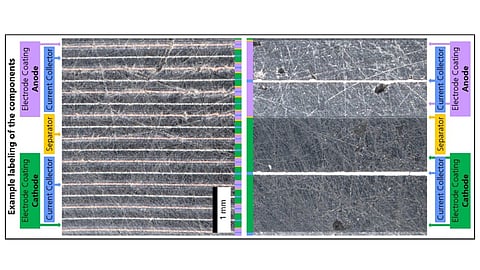


Fraunhofer ISE and its partners increased electrode coating thickness to as much as 800 µm
The design reduces the number of current collectors and creates more room for active material
The architecture was tested in lithium-ion, sodium-ion, and zinc-ion battery cells
Fraunhofer ISE and its project partners have developed thicker battery electrodes that allow cells to store 10% to 15% more energy without adding weight. They achieved this by modifying the electrode design to accommodate thicker coatings and reduce the number of current collectors needed.
A conventional battery cell uses many thin layers of electrode material and current collectors. The researchers increased the coating thickness from the usual range of 100 µm to 200 µm to as much as 800 µm. This reduced the number of current collectors and created more room for energy-storing active material, the researchers said.
“We have much more space for active material, which increases the energy density by 10 to 15 percent,” said Oliver Fitz, Group Leader for Battery Cell Technology at Fraunhofer ISE.
The research team first tested the electrode architecture in small zinc-ion, sodium-ion, and lithium-ion cells in the laboratory. It then produced lithium-ion pouch-cell prototypes with the new electrodes on a semi-automated production line at Fraunhofer ISE. According to Fitz, the concept can also be adapted to other battery chemistries.
The electrodes are PFAS-free and manufactured without toxic solvents. Fraunhofer ISE says a future production line could be less complex and require less space and energy than a conventional wet-coating line, reducing equipment and operating costs.
The technology was developed under the VORAN, INFAB, and WinZIB2 projects with research and industry partners. Machinery manufacturer acp systems AG is developing the electrode production equipment, while Helmut Hechinger GmbH & Co. KG is contributing its manufacturing expertise.
