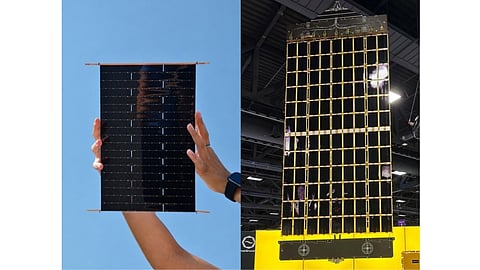


Fraunhofer ISE and Source Energy have developed silicon solar modules for satellites using shingle-matrix interconnection technology
The prototypes deliver up to 16.1 W, with an average active-area efficiency of 18.8% and specific power of 252 W/kg
M10 Solar Equipment provided the Shingle-Matrix Stringer for automated production at Source Energy’s Colorado facility
Germany’s Fraunhofer Institute for Solar Energy Systems ISE and US-based Source Energy have jointly developed a silicon solar module product line for satellites. The modules combine silicon solar cells with shingle-matrix interconnection and automated manufacturing. They are designed as a lower-cost alternative to the expensive and supply-constrained III-V solar technology commonly used in space, particularly for Low Earth orbit (LEO) satellites.
The prototype measures 321 mm × 209 mm, covers 629 cm² and weighs 64 g. The modules recorded an average power output of 15.6 W, while some modules achieved 16.1 W. They achieved an average active-area efficiency of 18.8% under air mass zero (AM0) conditions. Fraunhofer ISE says the specific power of 252 W/kg makes the module competitive with other silicon products in its class.
In the shingle-matrix design, individual solar cells are cut into strips and arranged with defined overlaps and spacing in a brick-like pattern. The strips are interconnected using an electrically conductive adhesive. TaiyangNews previously reported on a Source Energy space-grade module manufactured using M10’s shingle-matrix interconnection equipment (see SURFACE: M10 Solar’s Shingled Matrix Interconnection Tool).
Fraunhofer ISE says the matrix architecture offers resistance to localized physical damage, flexibility in module design and tolerance to extreme temperature variations. If part of the module is damaged by micrometeorites or space debris, the arrangement provides alternative paths for the current to flow around the affected area. The number of cell rows and columns can also be adjusted according to a satellite’s voltage and current requirements. The technology is compatible with wafer-based solar cells featuring front and rear contacts, including PERC and HJT, without requiring production-line modifications.
Following prototyping at Fraunhofer ISE’s Module-TEC facility in Freiburg, Source Energy installed a Shingle-Matrix Stringer developed by German solar production equipment company M10 Solar Equipment at its manufacturing facility in Colorado in June 2026.
“As the heart of our production, it enables us to manufacture PV panels for less than $5 per watt,” said Bryan Mazor, CTO at Source Energy. The automated manufacturing process also enables Source Energy to deliver the products within 6 months of receiving an order.
Source Energy subjected the module to space-qualification testing covering its resistance to extreme operating conditions. Based on the results, the company expects the module to retain 76% of its initial power output after 7 years of operation in space.
