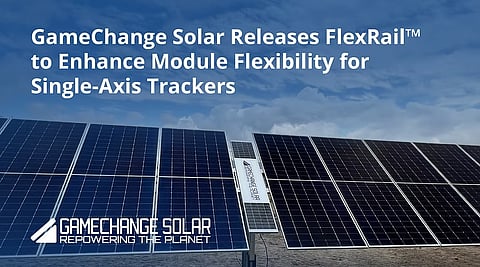

GameChange Solar’s FlexRail system has multiple mounting slots at intermittent spaces
Its ‘wide’ slot allows ±10 mm deviations in module mounting slot spacing along the width, while maintaining center-to-center distance and tracker table length
The product is commercially available
Connecticut, US-based PV tracker and fixed-tilt racking system provider GameChange Solar recently introduced FlexRail, a purlin-based module mounting structure that can accommodate PV modules of multiple dimensions in the same table length of the Genius series single-axis trackers.
According to the company, this latest rail system mitigates the potential risk of price escalation after tracker components are manufactured, stemming from post-installation changes in project design resulting from a change in module selection. These design tweaks amid ongoing installations might pose challenges, like differences in module spacing, table length, and mounting rail locations compared to the approved design. This rail system is fabricated with mounting slots at intermittent spaces of 400 mm, 790 mm, 990 mm, 1,100 mm, and 1,400 mm from the center of the rail along its length. This attribute facilitates seamless mounting of modules with varying length-side mounting holes, which exactly match the given slots. The company recommends bolting of the 400 mm slots, available on all PV module types, for low-wind-load-prone sections in a plant. Without quantifying these dynamic loads, the company says the 1,400 mm slots should be used in sections with high wind loads. Besides differences in module slot spacing (length side), modules of different makes might have varying mounting slot spacings along the width, which could affect module-to-module spacing and tracker table length. The FlexRail addresses this challenge by making its slots wide enough to allow ±10 mm deviations in mounting slot spacing, maintaining module center-to-center spacing and overall table length.

For clarity, GameChange Solar cites a case study of a proposed project in Florida, where the developer is considering 4 modules (A-D) of different dimensions at the design phase, before any materials are produced. These dimensions (L × W) are 2,266 × 1,134 mm, 2,384 × 1,114 mm, 2,264 × 1,134 mm, and 2,384 × 1,133 mm, respectively. While all the modules have mounting spacing at 400 mm and 1,400 mm intervals from the center of the length, Module A and Module D also have slots at 990 mm and 790 mm, respectively. Meanwhile, Module B and Module C feature intermediate slots at 1,100 mm intervals. These mounting slots perfectly match the FlexRail structure’s built-in slots for seamless installations with any of these modules in portrait configuration. In addition, mounting slot spacing (along the width) also differ: 1,084 mm, 1,066 mm, 1,084 mm, and 1,091 mm, respectively, for Module A, Module B, Module C, and Module D. Nevertheless, these rails with wider slots that allow ±10 mm deviation in module width, perfectly connect with any chosen modules, maintaining module center-to-center distance in the same tracker table length.
This flexibility in choosing from multiple module dimensions prevents potential field remediation or additional post-design installation costs for a single-axis tracker-based utility project, states the company. It also helps US project developers purchase tracker materials and ‘safe harbor’ them before finalizing modules.
Genius Tracker Product Director, Nat Healy, said, “Module supply is one of the most dynamic variables in utility-scale solar today.” He added, “By supplying trackers designed to support a wide range of module types, we help our customers maintain project schedules and protect their financial models, even when the customer changes modules late in the design or installation process.”
