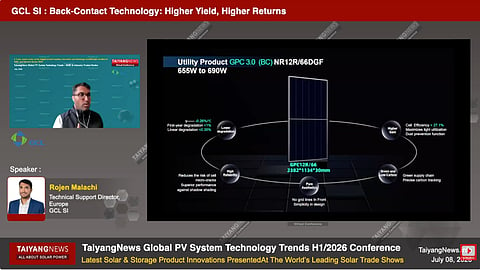


GCL SI reported achieving a BC cell efficiency of 27.3% at the TaiyangNews Next-Gen PV Technologies Conference 2026
Its upcoming utility-scale BC module offers power ratings from 655 W to 690 W, with deliveries planned for Q4 2026
The company’s large-format perovskite-BC tandem module reaches 26% efficiency and 720 W power output
GCL System Integration (GCL SI) presented its back-contact (BC) technology and related module portfolio at the TaiyangNews Next-Gen PV Technologies Conference 2026. Rojen Malachi, Technical Support Director, Europe, at GCL SI, discussed the company’s BC developments and products showcased earlier at SNEC and Intersolar Europe 2026.
GCL SI calls its proprietary BC cell architecture Graphical Precise-doping Passivation Contact (GPC), with GPC 3.0 representing its latest generation. According to Malachi, the GPC 3.0 BC cell has reached an efficiency of 27.3% through multilayer dielectric films to improve light absorption and the use of fluidized-bed reactor (FBR) granular silicon. The cell also uses damage-free laser-pattern passivation to reduce recombination losses and rear-contact metallization with fine-grid designs supporting zero-busbar (0BB) interconnection. GCL SI is targeting a cell efficiency of approximately 28.9% by early 2028.
At the module level, GCL SI uses a full-screen design in which adjacent cells slightly overlap, increasing the active area. According to Malachi, this provides a power gain of 10 W to 12 W. The company also uses rear-side interconnection and a low-temperature process designed to reduce thermal stress and wafer warping.
The company also uses a direct-formed half-cell process, in which wafers are divided before being processed into cells. This differs from the conventional approach of cutting finished cells and subsequently passivating their edges, says Malachi. He adds that the process reduces cutting losses and contributes approximately 5 W of additional module power.
To reduce the risk of microcracks, the company uses a linear, flat interconnection design instead of the conventional Z-shaped layout. According to Malachi, this distributes mechanical stress more evenly and reduces stress concentration at the cell edges.
Malachi also highlighted the module’s performance under partial shading. GCL SI uses what it calls reverse operating curve modulation to reduce hotspot temperatures and limit unnecessary bypass-diode activation. Under the company’s test conditions, with approximately 15% of the module shaded, the GPC module maintained hotspot temperatures of 100°C to 130°C, compared with 160°C to 180°C for a standard module. GCL SI claims the design can recover more than 30% of the power.
The GPC 3.0 modules have a temperature coefficient of -0.26%/°C, a first-year degradation of 1%, and subsequent annual degradation of 0.35%. Its lower power loss at high temperatures and slower annual degradation help it generate more electricity over its lifetime, says Malachi.
For the European distributed solar market, GCL SI offers a full-black module with power ratings ranging from 485 W to 500 W and a white-mesh variant ranging from 490 W to 505 W. The full-black module primarily targets residential installations, while the white-mesh variant is designed for C&I rooftops. At the conference, Malachi said the modules had been in production for more than 2 months.
The full-black modules come with 30-year product and performance warranties. GCL SI uses cell-level color sorting and automated module sorting to maintain a consistent appearance between modules. According to Malachi, the European modules have received IEC 61215 and IEC 61730 certifications.
GCL SI is also preparing a large-format GPC 3.0 module for utility-scale projects. Based on the 2.3 × 1.1 m format, the 66-cell module is expected to have power ratings between 655 W and 690 W. The company plans to begin deliveries in Q4 2026.
Malachi also presented the SiRo anti-glare module that is designed for installations near airports and highways. According to GCL SI, the module received a Triple-A anti-glare assessment from TÜV Rheinland.
Alongside its crystalline-silicon products, the company presented a large-format tandem module that combines a perovskite-coated top glass with a BC silicon cell underneath. The 2 layers absorb different parts of the solar spectrum. According to the company, the perovskite layer contributes approximately 75% of the module’s power generation, while the BC silicon cell provides the remaining 25%. The module measures 2.4 × 1.1 m, offers power ratings of 655-720 W, and reaches an efficiency of around 26%. It can also generate power from light entering its rear side, which GCL SI says is comparable to the rear-side generation of standard bifacial silicon modules.
The company manufactures these modules at the first phase of its 1 GW perovskite production facility in Kunshan, near Shanghai. The company expects manufacturing ramp-up and final product certification to be completed by the end of 2026.
