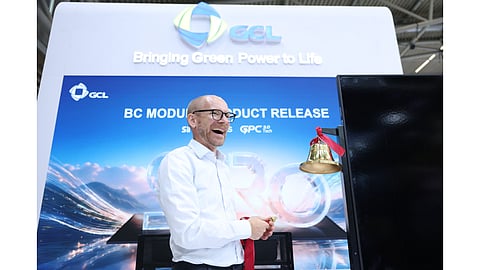


GCL SI officially launched its BC module platform at Intersolar Europe 2026
GPC 3.0 incorporates upgraded passivation, metallization, and cell design technologies, while mass-produced BC cells have reached 28.38% average conversion efficiency
The module reached an efficiency of 24.05% for a rated power output of 500 W
The demand for high efficiency and aesthetics is increasing in the selection of solar modules. And when the topic is aesthetics, back-contact (BC) modules come to the fore. One can observe from recent exhibitions that manufacturers are increasingly focusing on BC modules. Leading module manufacturers, which have already invested in the technology, are now launching new modules and improving existing ones.
Notable among these was GCL System Integration (GCL SI) launching its BC module during Intersolar Europe 2026. The newly introduced module targets residential, commercial & industrial (C&I), and building-integrated photovoltaics (BIPV) applications. This full-screen, all-black module is currently rated at 475-500 W, with module efficiencies of 23.27% to 24.05%, and dimensions of 1,800 × 1,134 × 30 mm. It is backed by a 30-year product warranty and a 30-year linear performance warranty with annual degradation of 0.35%.
The module is based on GCL’s proprietary cell architecture, Graphical Precise doping passivation Contact (GPC). The company introduced a module based on GPC 1.0 technology in 2024, followed by a GPC 2.0 module launch in January 2025. The latest GPC 3.0 module features several upgrades, including an optimized full-screen cell layout, advanced passivation, multilayer gradient dielectric films, improved metallization, and the use of fluidized-bed reactor (FBR) granular silicon. According to the company, its mass-produced GPC BC cells have achieved an efficiency of 28.38%, exceeding the 28.2% target announced in its roadmap. GCL SI also highlighted progress in advanced metallization approaches, including zero-busbar (0BB) and silver-reduction approaches to reduce material consumption and production costs.
GengWeng Huang, Executive Dean of GCL SI's Cell Research Division, says that BC is the ultimate architecture for crystalline silicon cells. Other technologies, such as TOPCon and HJT, are reaching their limits, and BC has more room for efficiency improvements.
GCL SI has officially commenced the commercial rollout of its GPC 3.0 to the European Market.
