
Key takeaways:
Residential energy systems are evolving toward integrated setups combining generation, storage, and grid interaction
Storage is increasingly used for autonomy and resilience, beyond just cost savings
Smart energy management systems use data and forecasts to optimize energy use under dynamic tariffs
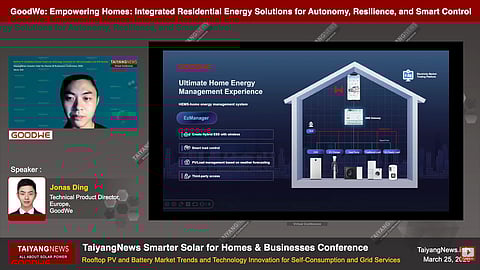
GoodWe, an inverter and battery supplier until 2021, is providing integrated solutions, especially for the residential market. Jonas Ding, Technical Product Director for Europe, presented the company’s approach to integrated residential solar energy systems at the TaiyangNews Smarter Solar for Homes and Businesses Conference 2026.
Starting in 2025, GoodWe’s focus is on combining generation, storage, load, and grid interaction to support prosumers – consumers who also act as energy producers.
He noted that geopolitical uncertainty, volatile energy prices, and concerns about grid stability are pushing more household consumers toward prosumerism. As a result, the role of storage is shifting from cost savings to autonomy, resilience, and smart control.
GoodWe’s portfolio includes building-integrated PV (BIPV), inverters, batteries, heat pumps, EV chargers, and grid-support functions. The company says its integrated solution is designed to address self-consumption, peak shaving, and dynamic tariffs. It prioritizes households and stores excess energy in batteries, exporting it to the grid when needed. The peak-shaving function works by discharging the battery when energy demand is high, thereby reducing energy use from the grid and avoiding higher energy bills. In addition, with dynamic electricity tariffs, there is scope to optimize when to draw from or feed into the grid.
The company’s home energy management system (HEMS) integrates consumption, storage, and electricity trading. It can also use weather forecasts to adjust energy usage, says GoodWe. AI-based control can optimize usage in response to tariffs and demand. Ding said that the company offers modular residential storage systems with capacities of 5, 6, 8, and 9 kWh, available in single- and 3-phase configurations.
At the end of his talk, titled Empowering Homes: Integrated Residential Energy Solutions for Autonomy, Resilience, and Smart Control, Ding presented a case study from Ireland in which a 10 kW PV system was combined with a 16 kWh battery. Over 2 weeks, the system demonstrated optimized energy use. The average daily cost was €7.23, with savings of about €17.66 per day using PV and storage. On cloudy days, savings were lower, with a cost reduction of around 16.7%. Prediction accuracy over a 1-hour window was reported at 92%.

