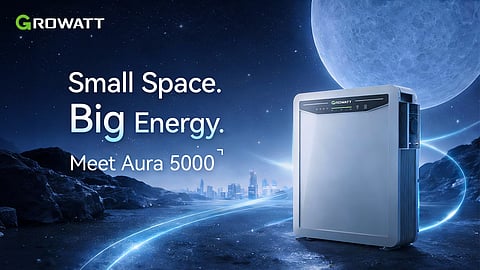

Growatt has launched its AURA 5000 series balcony ESS
This AC-coupled ESS is suitable for retrofitting urban household solar-plus-storage projects, eliminating the rewiring of existing PV capacities
It features an RF-based communication system, which enables scheduling of charging/discharging and self-consumption without internet connectivity
China-based PV inverter and storage solutions provider Growatt has unveiled its AURA 5000 energy storage solution (ESS) for urban household applications such as balcony PV, apartment solar storage, and retrofitting of existing storage systems.
The company says that the ESS is equipped with lithium-iron-phosphate (LFP) battery stacks with a cumulative capacity (charging/discharging) of up to 5 kWh and a bidirectional inverter of up to 2.5 kVA. Given this configuration, which supports an AC-coupled architecture with an existing hybrid inverter, this solution directly connects to the outgoing AC panel. This, in turn, prevents any rewiring of existing PV capacity, unlike DC-coupled alternatives, for retrofitting projects. The company states that its ‘compact’ design also helps installation in space-constrained areas with a form-factor tailored for apartments, villas, balconies, and urban homes.
In terms of operational functionalities, the ESS switches to backup mode within 20 ms of grid outages or failures. It delivers a power backup of up to 2.5 kVA for up to 2 hours at the rated discharge rate continuously. In addition to emergency backup, it supports electricity arbitrage (peak-shaving and valley-filling) by charging with excess solar generation or grid electricity (during low tariffs) and discharging when the tariff rises throughout the day. According to the company, the ESS performs this complex operation, aligning with the charging/discharging scheduling, with the help of an embedded AI-powered energy management system.
On the communication side, unlike conventional residential WiFi-based network communication systems, it offers radio-frequency (RF)-based local ‘smart’ control, eliminating network dependence. Equipped with an RF smart meter solution that features a smart meter (SEM5-1) and an infrared meter reading head (SMeter-RS02), this ESS offers offline intelligent energy management. The company states this allows scheduling and self-consumption without internet or a secondary setup for network connectivity.
Growatt offers warranties for its batteries with a lifecycle of more than 6,000 cycles (charging/discharging), equivalent to up to 10 years. This can be started even in severe cold environments without failure.

