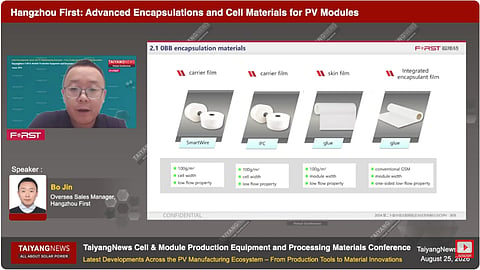


Hangzhou First offers carrier, skin, and integrated encapsulant films for different 0BB interconnection processes
Its PIB edge seal can reportedly reduce the required creepage distance in a 1,500 V module from 10.4 mm to 3.5 mm
The portfolio also includes buffer films, string-busbar insulation strips, and functional inks for BC and HJT cell production
Hangzhou First, a Chinese supplier of encapsulation materials, offers encapsulant films, edge sealants, insulation materials, and functional inks. During the recent TaiyangNews Global PV System Technology Trends Conference, its Overseas Sales Manager, Bo Jin, presented materials developed for zero-busbar (0BB) interconnection, ultra-narrow module-edge clearance, multi-cut cells, and advanced cell production.
Jin explained that 0BB encapsulation materials must be selected according to how the interconnection wires are attached to the cells. The main approaches include SmartWire-type interconnection, integrated film covering (IFC), adhesive fixation, and soldering reinforced with adhesive. Hangzhou First offers carrier films for the first two processes. In the SmartWire approach, the wires and film are thermally laminated into a composite before the cells are interconnected. With IFC, the film holds the wires directly against the cell surface while the cells are connected into strings.
For glue-based interconnection, the company offers a thin skin film that keeps the wires in position until they are fixed during lamination. It is used together with a standard encapsulant. Hangzhou First also provides an integrated film that combines both materials, with the skin-film side facing the cell and the encapsulant side facing the glass. The carrier and skin films weigh around 100 g/m² and have controlled flow properties to limit movement during lamination.
Another focus was edge insulation for modules with ultra-narrow edge clearance. According to Jin, conventional module construction requires a minimum creepage distance of 10.4 mm between live components and accessible outer surfaces. When an edge seal is used as relied-upon insulation, the required distance can reportedly be reduced to 3.5 mm in a 1,500 V module. This lets manufacturers use larger cells or increase the active area without increasing overall module dimensions.
Hangzhou First has worked on polyisobutylene (PIB) edge-sealing materials since 2015. Its Linkermen PIB is available as a dispensable sealant, tape, and preformed patches, with the patch format used around the junction-box area. The company has an annual production capacity of around 2,000 tonnes. Its portfolio includes PIB-401 for crystalline-silicon modules and PIB-405 for perovskite modules.
The company reports that the PIB maintained peel strength above 20 N/cm after aging, while shear-strength retention exceeded 100%. The tested material showed no delamination or bubbles. Moisture-indicator tests also showed limited moisture ingress following thermal cycling, humidity-freeze, and ultraviolet and damp-heat exposure. According to the company, volume resistivity and breakdown strength remained stable after the tests.
For multi-cut and shingled modules, Hangzhou First introduced an EVA-based buffer film placed between overlapping cell sections. The material cushions the cut cells and reduces mechanical stress during lamination. Its hardness, modulus, and flow are balanced to prevent the film from becoming too rigid or flowing excessively. It also provides adhesion to the cells and encapsulant. High optical transmittance makes the overlap less visible, while the company said the yellowing index remained controlled after damp-heat testing.
Hangzhou First also presented an insulation strip placed between cells and string busbars. The strip is mainly PET-based, with coatings on both sides and optional encapsulant layers. It electrically separates the busbars from the cells beneath them, improves adhesion, and reduces the risk of microcracks. Transparent, white, and black versions are available, and the company says the material resists yellowing during ultraviolet and damp-heat exposure.
At the cell level, Jin presented insulating, protective, and patterning inks. The insulating ink separates the positive and negative fingers on the rear of BC cells to prevent short circuits. Hangzhou First offers thermally cured FT-series and UV-cured FURA-series inks. According to Jin, the material is already being used by BC cell manufacturers. The company reports that it retains its adhesion to the cell and encapsulant after 2,000 hours of damp-heat testing.
The protective ink is applied to the front of a completed BC cell as the final step in cell production. It prevents scratches when cells are stacked and packed, removing the need to place separator paper between individual cells. The UV-cured ink can be applied by inkjet or screen printing. Its surface pattern disappears during module lamination, but the material remains inside the module. The company reports no adverse effect on cell or module performance, and no yellowing or delamination after 48 hours of pressure-cooker testing and 16 hours of high-temperature baking.
Hangzhou First also presented its LPR-E etch-resist ink for forming the interdigitated p- and n-type regions of BC cells. The ink is printed over selected areas, protects them during hydrofluoric acid etching, and is subsequently removed. The company claims that it provides high pattern precision and can be stripped without leaving residues or flocculent material.
A second patterning product, LPR-P, is designed for copper metallization of HJT cells rather than BC cells. The plating-resist ink is printed over a copper seed layer, leaving selected areas open for copper deposition. After plating, the ink and the exposed parts of the seed layer are removed. According to Hangzhou First, the ink offers resolution down to 7 µm, high photosensitivity, and resistance to the chemicals used during plating.
Watch the full presentation video here.
Hangzhou First also participated in the TaiyangNews Encapsulation Materials & Backsheet Market Survey 2026, which is available for free download here.
