
Key takeaways:
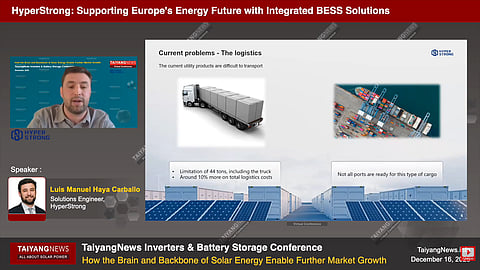
Luis Manuel Haya Carballo of HyperStrong highlighted logistics constraints of large 20-ft BESS containers as a key challenge at utility scale
Smaller, modular storage units improve transport feasibility and allow denser site layouts
Growing demand for longer-duration storage is shifting systems toward 4-8 hour configurations
Storage integration is becoming a key requirement in all PV market segments, be it residential, commercial, or utility-scale systems. However, there are still some challenges that need to be addressed. Unlike the wall battery or smaller storage systems used in residential installations, utility-scale storage systems use large containers, often termed battery energy storage systems (BESS). These occupy large spaces of land, which can be reduced by increasing their energy density.
HyperStrong, a China-based energy storage systems provider, shared its findings and solutions at the TaiyangNews Inverters & Battery Storage Conference. Luis Manuel Haya Carballo presented the company’s product evolution and performance improvements.
According to Carballo, the industry has matured to move past the issues of the initial phase, such as fire safety, round-trip efficiency, and basic system reliability. Most tier 1 suppliers today offer fairly mature products where these aspects are largely addressed. The focus is shifting to a new set of constraints that are more visible at scale.
One of the key issues Carballo highlighted is logistics. The commonly used 20-ft containerized systems, typically offering around 5 MWh capacity, have become standard across the industry. However, these units often weigh close to 40 t, which creates challenges for transportation, especially in regions like Europe where road limits are typically around 40-44 tons, including the truck. This leads to additional permits, higher transport costs, and limitations at ports and routes. As projects scale up, these constraints start to significantly affect overall project economics.
Another important challenge is site-level energy density. While energy density inside the container has improved, the overall project footprint still remains relatively large due to spacing requirements for maintenance, thermal management, and safety. In many existing installations, there is considerable unused space between containers, which reduces the storage capacity installed per square meter.
To address these issues, Carballo described a shift toward more modular system designs. Instead of relying on larger 20-foot containers, the approach is shifting toward smaller 10-foot units with around 3.2 MWh capacity each. By reducing the size and weight of individual units (to roughly 24 tons), transportation becomes easier and avoids many of the regulatory and logistical constraints associated with heavier systems.
The modular approach also enables more flexible layouts. Design changes, such as relocating thermal management systems to the top of the container, enable units to be placed much closer together, down to a few centimeters in some configurations. This allows for higher site-level energy density and more efficient land use. At the same time, smaller units can improve operational availability, since a fault in one unit affects a smaller portion of the total system compared to larger containers.

Carballo also pointed to the rise in software and data-driven control in BESS systems. Modern platforms are combining onboard battery management systems with higher-level monitoring and control through cloud-based systems. These systems can track cell-level parameters and use predictive algorithms to identify potential issues before they occur.
At the end of his talk, titled Supporting Europe's Energy Future with Integrated BESS Solutions, Carballo also mentioned a trend toward longer-duration storage. While 2-hour systems were common earlier, the market is now increasingly shifting toward 4-hour, 6-hour, and 8-hour configurations for utility applications.
